Higher Secondary Education in India: What You Need to Know
When you're in higher secondary education, the final two years of school before college, typically grades 11 and 12 in India. Also known as Class 11 and 12, it's not just another phase of school—it's the make-or-break stage that decides if you walk into IIT, AIIMS, or a vocational path. This isn’t theory. It’s where your future career starts taking shape, whether you’re aiming for engineering, medicine, or something else entirely.
Most students in India follow either CBSE, the Central Board of Secondary Education, the most widely adopted curriculum across the country. Also known as Central Board, it’s the default choice for students targeting JEE and NEET because its syllabus lines up directly with those exams. But if you’re in states like Maharashtra or West Bengal, you might be on ICSE, the Indian Certificate of Secondary Education, known for a broader, more detailed syllabus. Also known as CISCE, it gives you deeper exposure to English and science—but doesn’t always match the exam patterns of JEE or NEET as closely. The board you’re on affects your study plan, your stress levels, and even your chances of cracking top entrance exams.
Higher secondary education isn’t just about boards. It’s where you start choosing your path. If you pick science, you’re diving into chemistry—a subject that’s surprisingly the most scoring in JEE because it’s predictable, NCERT-heavy, and doesn’t demand the same level of abstract thinking as physics or math. If you’re going for medical, NEET becomes your whole world. Coaching centers, study material from Aakash or Allen, and daily practice become non-negotiable. Even if you’re not aiming for engineering or medicine, this stage sets your foundation for any career—whether it’s data science, pharmacy, or even starting your own business.
You’ll hear people say, "You can self-study for JEE"—and they’re right. But only if you know what to study, when to study it, and how to stay consistent. The same goes for NEET. Skipping physical chemistry? Maybe. But only if you’ve already mastered the high-yield topics and know exactly what you’re giving up. Higher secondary education doesn’t give you a second chance. One bad year, and you’re either stuck repeating or settling for less.
And it’s not just about academics. This is when you start figuring out what kind of learner you are. Do you need a coaching center? Or can you thrive with YouTube videos and old question papers? Are scholarships your only way forward? Do you need a certificate that opens doors, or is a degree the only path? The answers to these questions start here—in higher secondary education.
Below, you’ll find real, no-fluff advice from students who’ve been there: how to pick the right board, what to skip in chemistry, which coaching actually works, and how to survive the pressure without burning out. This isn’t a generic guide. It’s what actually helps people get through.
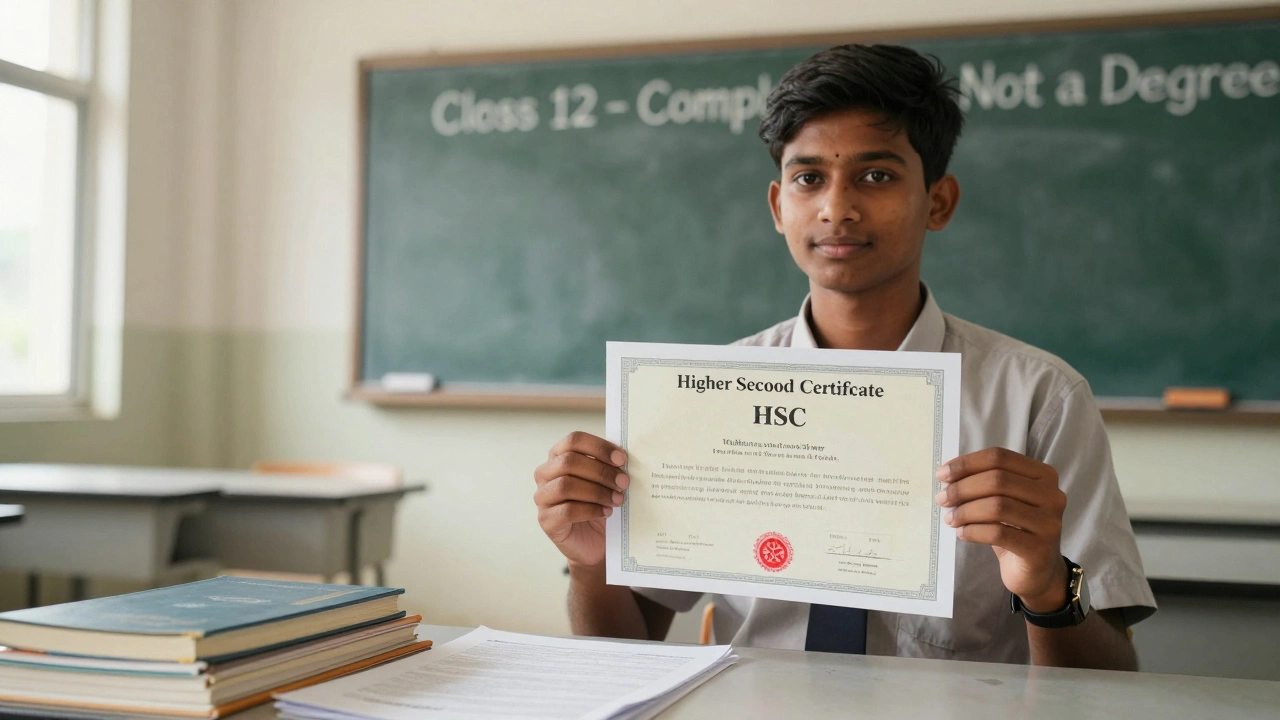
What Is a 12th Class Degree Called in India? Understanding the Indian Education System
Dec, 1 2025
In India, Class 12 is not a degree - it’s a certificate of higher secondary education. Learn what it's really called, how it differs from degrees, and why using the right terms matters for college and jobs.