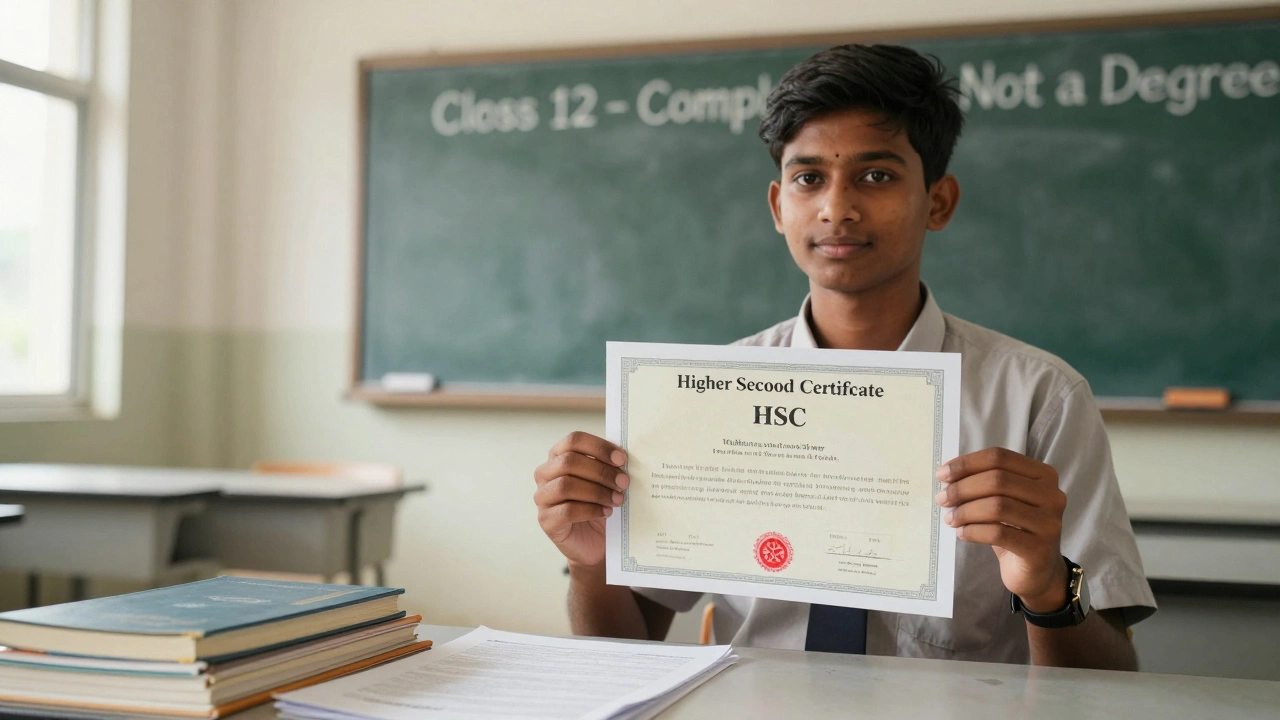
Class 12 Certificate Clarifier
Class 12 Certificate Guide
In India, Class 12 is a certificate - not a degree. Select your board and stream to see the correct terminology for your certificate.
Remember: Degrees (like B.A., B.Tech, B.Com) are earned after Class 12, typically during your undergraduate studies.
In India, there is no such thing as a "12th class degree." That term doesn’t exist in the official education system. If you hear someone say "I got my 12th class degree," they’re using incorrect language. What they actually mean is they completed their Higher Secondary Education - also called Class 12 or the 12th standard.
What You Actually Receive After Class 12
After finishing Class 12 in India, students get a passing certificate or school leaving certificate from their board. This is not a degree. It’s proof you finished secondary education. The exact name depends on which board you took your exams under:
- CBSE (Central Board of Secondary Education): Certificate of Secondary Education (Class 12)
- ICSE (Council for the Indian School Certificate Examinations): Indian School Certificate (ISC)
- State Boards: Higher Secondary Certificate (HSC) - like Maharashtra HSC, Tamil Nadu HSC, etc.
These are all certificates. Not degrees. Degrees come later - after college.
Why People Confuse "Certificate" With "Degree"
This mix-up happens all the time, especially in rural areas or among families who don’t have direct experience with higher education. Many parents and even teachers say "degree" when they mean "completion." It’s a common mistake, not a formal term.
Think of it like saying "I got my high school diploma" in the U.S. - that’s not a degree. It’s the final step before college. In India, Class 12 is the same. It’s the end of school, not the start of university.
The confusion gets worse when people see "Bachelor’s Degree" on job applications and assume Class 12 must be "something like that." But a degree requires three to four years of study after Class 12 - like a B.A., B.Sc., or B.Com.
How the Indian Education System Works
To understand why Class 12 isn’t a degree, you need to see the full structure:
- Primary School: Classes 1 to 5
- Upper Primary: Classes 6 to 8
- Secondary: Classes 9 to 10 - ends with the Class 10 board exam
- Higher Secondary: Classes 11 to 12 - ends with the Class 12 board exam
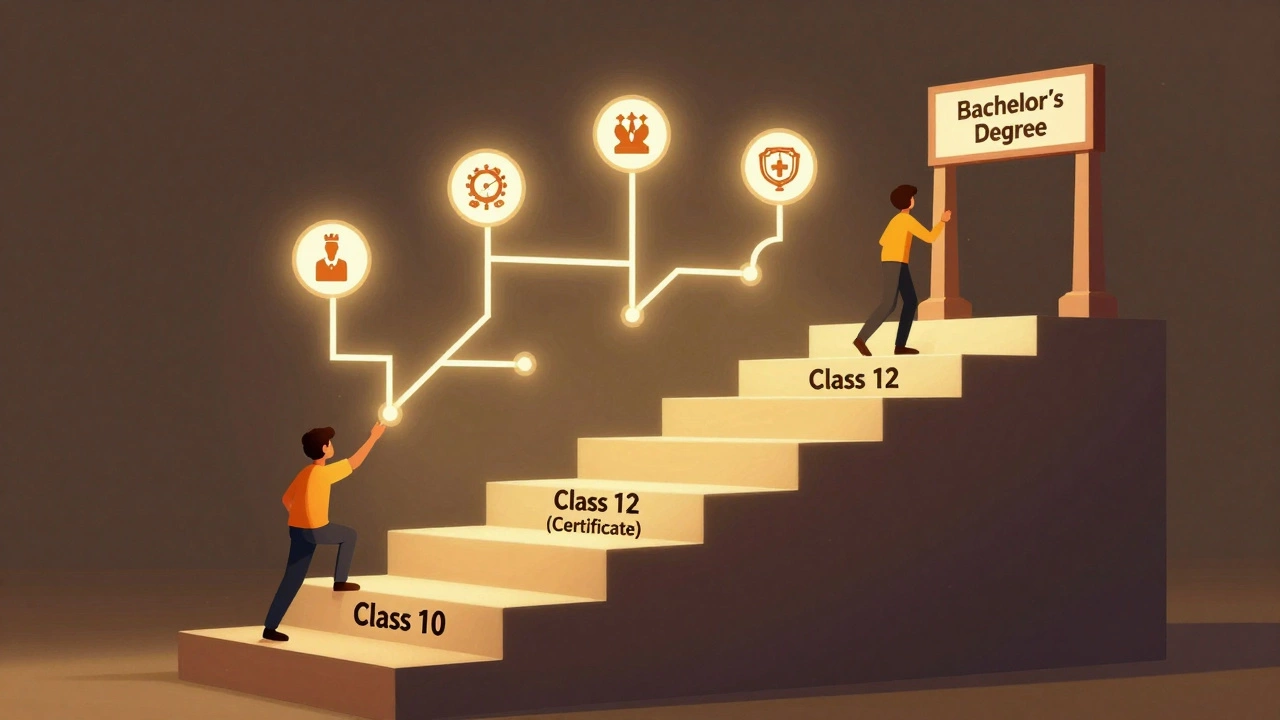
- Undergraduate: 3-4 years after Class 12 - this is where you earn your first degree
- Postgraduate: 1-2 years after a bachelor’s - Master’s degree
Class 12 is the bridge between school and college. It’s the gatekeeper. Your Class 12 marks determine whether you can get into a good college, which stream you can choose (Science, Commerce, Arts), and even which competitive exams you’re eligible for - like JEE, NEET, or CUET.
What Happens After Class 12?
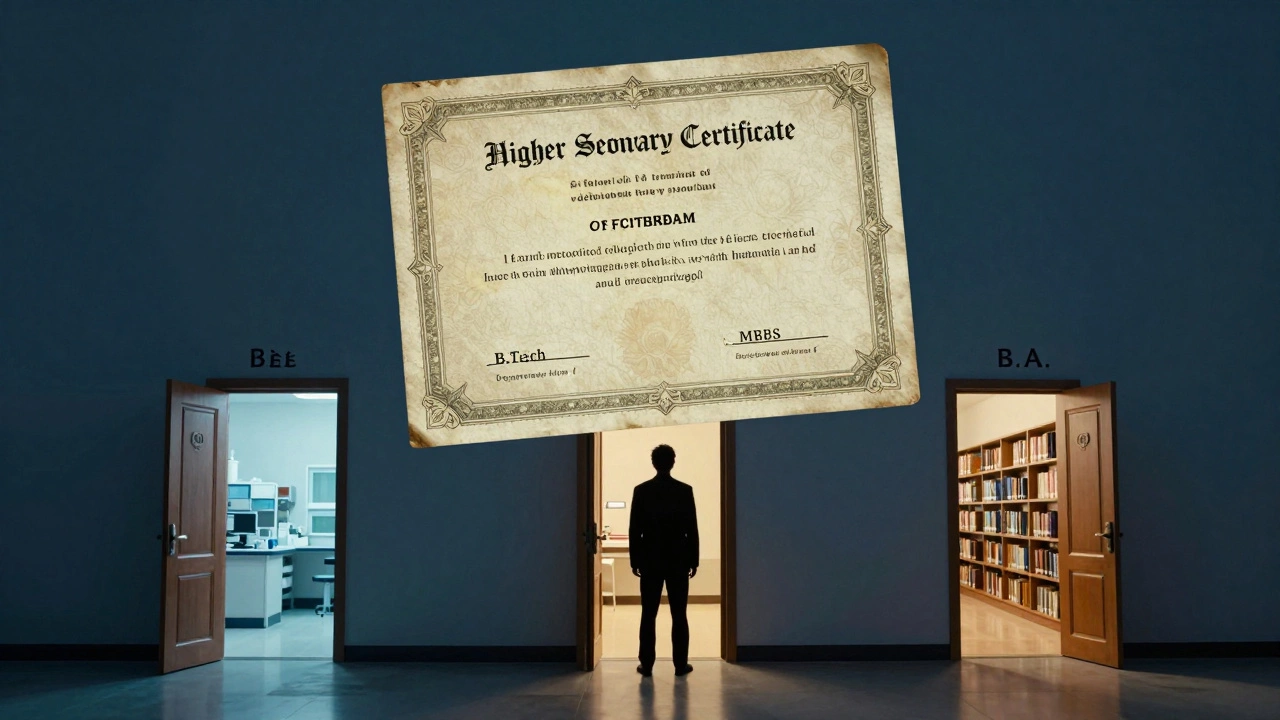
After you pass Class 12, you have options - but none of them involve a "degree" yet.
If you’re in the Science stream, you might apply for:
- B.Tech (4-year engineering degree)
- B.Sc. (3-year science degree)
- B.Pharm (Bachelor of Pharmacy)
- MBBS (5.5-year medical degree)
If you’re in Commerce:
- B.Com (Bachelor of Commerce)
- BBA (Bachelor of Business Administration)
- CA Foundation (Chartered Accountancy - starts after Class 12)
Arts students often go for:
- B.A. (Bachelor of Arts)
- B.Ed. (Bachelor of Education - for teaching)
- BA LLB (Integrated law degree)
None of these are available until after you’ve passed Class 12. That’s why Class 12 is so important - it’s not the end goal. It’s the starting line.
What About Diplomas and Certificates?
Some students skip college after Class 12 and join diploma courses - like Diploma in Engineering, Hotel Management, or Nursing. These are not degrees either. They’re vocational certificates that usually take 1 to 3 years.
These diplomas can lead to jobs, and sometimes even lateral entry into the second year of a degree program. But again - they’re not degrees. They’re shorter, skill-based programs.
Even online certifications from platforms like Coursera or NPTEL aren’t degrees. They’re just certificates of completion.
How to Correctly Describe Your Qualification
If you’ve completed Class 12, here’s how to say it properly:
- "I completed my Class 12 from CBSE."
- "I passed my Higher Secondary Examination."
- "I have my 12th standard certificate."
- "I am a Class 12 pass-out."
Avoid saying:
- "I have my 12th degree." (Incorrect)
- "I got my 12th class graduation." (Incorrect)
- "I earned my Class 12 degree." (Incorrect)
Using the right terms matters - especially when filling out college applications, job forms, or visa documents. Getting this wrong can cause delays or rejections.
Why This Matters for International Students
If you’re applying to universities abroad, your Class 12 certificate is your equivalent of a U.S. high school diploma or the UK’s A-Levels. But foreign institutions don’t call it a degree. They call it "secondary school completion" or "pre-university qualification."
When you submit your documents, you’ll need to send your Class 12 mark sheet and passing certificate. Some countries require an evaluation - like WES in Canada or UK ENIC in the UK. They’ll match your Class 12 to their local system. But they won’t call it a degree.
So if you’re telling a Canadian university you have a "12th class degree," they’ll be confused. You need to say: "I completed my Higher Secondary Education in India, equivalent to a U.S. high school diploma."
What About the Term "Senior Secondary"?
You might hear "Senior Secondary" used instead of "Higher Secondary." That’s just another name for the same thing - Classes 11 and 12. The CBSE website uses "Senior Secondary" officially. But again - it’s not a degree. It’s a level of education.
Some schools label their certificates as "Senior Secondary Certificate." That’s fine. It’s still a certificate. Not a degree.
Common Misconceptions
Here are three myths you should forget:
- Myth: "Class 12 is a degree." Truth: It’s a completion certificate.
- Myth: "You get a degree after 12th if you pass with 80%+." Truth: Percentage doesn’t change the type of document. A 95% pass is still a certificate.
- Myth: "Diploma after 12th is a degree." Truth: A diploma is a credential, not a degree. Degrees are awarded by universities, not technical institutes.
These myths spread because of how people talk, not because they’re true. The education system doesn’t change based on how we speak.
What You Should Do Next
If you’ve just passed Class 12:
- Keep your original mark sheet and passing certificate safe. Make digital copies.
- Check the eligibility criteria for the colleges or courses you want to apply to.
- If you’re aiming for JEE, NEET, CUET, or other entrance exams, start preparing immediately.
- Don’t wait for "degree" - start thinking about your next step: college, diploma, or job.
If you’re helping someone else - a sibling, a cousin, a student - correct the language gently. Say: "You didn’t get a degree. You passed Class 12. Now you’re ready for your real degree."
Final Thought
Class 12 is a big deal - but not because it’s a degree. It’s a big deal because it opens doors. It’s the last exam you take as a school student. After this, you choose your path: engineer, doctor, teacher, entrepreneur, artist. The certificate you hold doesn’t define you. What you do after it does.
Is Class 12 the same as a diploma?
No, Class 12 is not a diploma. Class 12 is the completion of school-level education, certified by boards like CBSE or state boards. A diploma is a vocational or technical qualification, usually taken after Class 12, lasting 1-3 years. Diplomas are offered by polytechnics or institutes, not schools. They’re not degrees either, but they focus on job skills rather than academic theory.
Can I call my Class 12 certificate a "higher secondary degree"?
No. "Higher secondary" is the level of education - Classes 11 and 12. The document you receive is called a "Higher Secondary Certificate" (HSC) or "Senior Secondary Certificate." The word "degree" is reserved for university-level qualifications like B.A., B.Sc., or B.Tech. Using "degree" here is incorrect and may cause confusion in official forms or abroad.
Is Class 12 equivalent to a high school diploma in the U.S.?
Yes, Class 12 in India is considered equivalent to a U.S. high school diploma for admission purposes. Universities in the U.S., Canada, Australia, and the UK recognize it as the completion of secondary education. However, they do not call it a "degree." You’ll need to submit your mark sheet and certificate, and sometimes get it evaluated by agencies like WES or ECE.
What documents do I need after Class 12?
You need your original Class 12 mark sheet and passing certificate issued by your board (CBSE, ICSE, state board). Always keep at least two original copies. Make scanned PDFs and printed copies. If applying abroad, you may need a transcript, a certificate of equivalence, or an affidavit. Some colleges also ask for a migration certificate if you’re switching boards.
Can I get a degree without doing Class 12?
No. In India, Class 12 is the mandatory qualification to enroll in any undergraduate degree program - whether it’s B.A., B.Sc., B.Com, B.Tech, or MBBS. Even open universities like IGNOU require Class 12 for admission to bachelor’s courses. There are no legal shortcuts. If you didn’t pass Class 12, you must complete it before pursuing a degree.