
Career Path Matcher: Vocation vs. Trade
Tell us about yourself
Complete the questions to see if you are better suited for Vocational Training or Skilled Trades.
Picture this: You’re standing at a crossroads. One path leads to a university lecture hall with degrees and diplomas. The other leads to a workshop, a construction site, or a kitchen line. Both paths promise a career, but they speak different languages. One talks about "vocations" and the other about "trades." If you’ve ever wondered whether these terms are just fancy synonyms for manual labor, you aren’t alone. The confusion is real, and it often stops people from picking the right training program.
So, is vocation the same as trade? Short answer: No. Long answer: They overlap significantly, but they serve different purposes in your career journey. Understanding the distinction can save you thousands of dollars in tuition and years of wasted time. Let’s break down exactly what each term means, how they differ, and which one might fit your life goals better.
What Exactly Is a Vocation?
The word vocation comes from Latin roots meaning "to call." In modern career terms, a vocation refers to a strong feeling of suitability for a particular career or occupation, often linked to personal passion or service. While we use it broadly today, historically it implied a calling-something you felt destined to do, like teaching, nursing, or social work.
In the context of education, vocational education is the broader umbrella. It includes any training that prepares you for a specific job, role, or industry. This could mean getting a certificate in digital marketing, learning culinary arts, or studying early childhood education. Vocational programs focus on practical skills rather than theoretical knowledge. You aren’t just reading about how to cook; you’re chopping onions in a professional kitchen. You aren’t just studying child psychology; you’re managing a classroom simulation.
Vocations can lead to white-collar jobs, blue-collar jobs, or creative roles. The key is the intent: vocational training is designed to get you hired quickly by giving you the exact skills employers need right now. It’s efficient, targeted, and results-oriented.
Defining the Skilled Trades
Now, let’s look at trade, specifically a skilled profession requiring specialized training, often involving manual dexterity, physical labor, and technical expertise in fields like construction, manufacturing, or repair. When people say "the trades," they usually mean jobs like electrician, plumber, welder, carpenter, HVAC technician, or machinist. These are hands-on roles where you build, fix, or maintain the physical world around us.
Trades are distinct because they almost always require formal apprenticeships. An apprenticeship combines paid on-the-job training with classroom instruction. For example, an aspiring electrician might spend four years working under a master electrician while taking night classes on electrical codes and safety regulations. This model ensures that when you finish your training, you’re not just theoretically knowledgeable-you’re physically competent and certified to work independently.
Trades are heavily regulated. You need licenses to pull permits, sign off on work, and ensure public safety. A mistake in wiring a house can cause a fire; a mistake in plumbing can contaminate water supplies. That’s why the barrier to entry is high, but so is the job security. Infrastructure doesn’t stop needing repairs just because the economy slows down.
Key Differences Between Vocation and Trade
To really see the difference, we need to look at structure, outcome, and progression. Here is a breakdown of how these two paths diverge in practice.
| Feature | Vocational Training (Vocation) | Skilled Trades (Trade) |
|---|---|---|
| Training Format | Certificate programs, diplomas, short courses (weeks to 2 years) | Apprenticeships (3-5 years), combining work and study |
| Primary Focus | Broad skill sets for specific industries (healthcare, IT, admin) | Specialized technical skills for physical infrastructure (construction, repair) |
| Licensing | Varies; some require certification, others don’t | Mandatory licensing/journeyman status for most roles |
| Physical Demand | Low to moderate (often office or clinical settings) | High (manual labor, outdoor work, heavy equipment) |
| Earning Potential | Steady growth, often tied to degree/certification level | High starting pay, potential for union wages or business ownership |
Notice the timeline. Vocational courses can be completed in months. If you want to become a medical assistant, you might finish a program in six months and start working immediately. Trades take longer because mastery requires repetition and supervision. You can’t learn to weld steel safely in six weeks. You need thousands of hours of practice.
Another major difference is the nature of the work environment. Vocational roles often operate in controlled environments-offices, hospitals, schools, or labs. Tradespeople work wherever the problem is: inside walls, on rooftops, in crawl spaces, or on active construction sites. The unpredictability of the trade environment demands adaptability and physical resilience that vocational roles rarely require.

Why the Confusion Exists
So why do people mix them up? Because both fall under the banner of "post-secondary non-degree education." Traditional universities push four-year degrees as the only valid path to success. Anything else gets lumped together as "alternative" or "vocational." But within that alternative bucket, there’s a massive gap between getting a certificate in bookkeeping and spending five years apprenticing as a pipefitter.
Also, language evolves. Many trade schools now call themselves "technical colleges" or "career institutes" to sound more academic. Conversely, some vocational programs offer "trade-related" certificates, like basic carpentry or auto repair, without the full apprenticeship structure. This blurs the lines further. If you take a three-month course in welding, are you a tradesperson? Technically, no. You’re trained, but you’re not licensed. You lack the journeyman status that defines a true trade.
Choosing the Right Path for You
Deciding between a vocational route and a trade depends on your personality, physical capabilities, and financial goals. Ask yourself these questions:
- Do you prefer working with your hands or your mind? If you enjoy tangible results-seeing a cabinet you built or a circuit you wired-trades might suit you. If you prefer analyzing data, managing patients, or designing graphics, vocational courses in healthcare or tech are better fits.
- How much time can you invest upfront? Trades require a long-term commitment. You’ll earn while you learn, but progress is slow. Vocational programs are faster. You pay upfront (or through loans) and enter the workforce quickly.
- Are you okay with physical strain? Trades are hard on the body. Back pain, joint issues, and exposure to weather are common. If you have existing physical limitations, consider less demanding vocational options.
- Do you want to start your own business? Tradespeople frequently become self-employed contractors. Once you’re licensed, you can buy tools, hire helpers, and run your own company. Vocational careers often follow a corporate ladder, though entrepreneurship is possible in fields like cosmetology or IT consulting.
Consider your income expectations too. Entry-level vocational jobs might pay modestly, but they can lead to higher-paying roles with additional certifications. Trades often pay well from day one, especially in unionized sectors. In Canada, for instance, journeyperson electricians and plumbers can earn over $80,000 annually, with overtime pushing that higher. Vocational roles like administrative assistants might start closer to $40,000-$50,000, depending on location and experience.
The Future of Work: Which Path Is Safer?
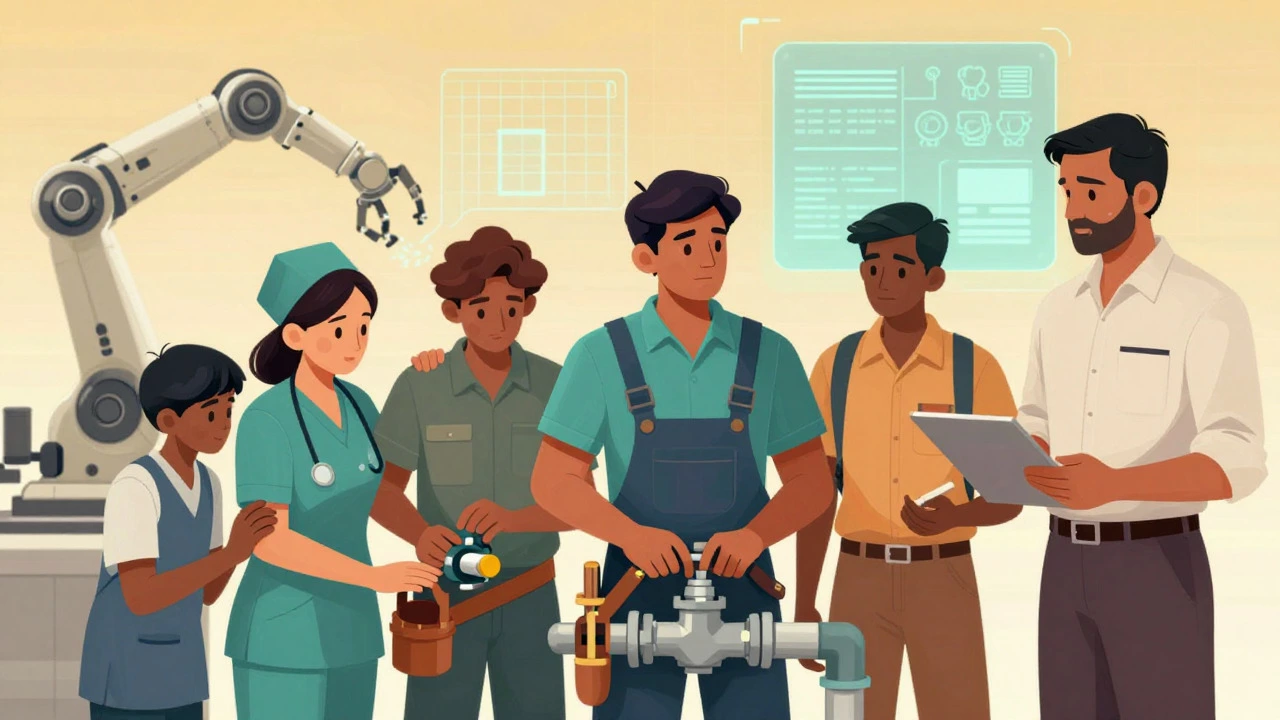
With AI and automation changing the job market, many wonder which path is safer. Interestingly, both vocations and trades are relatively resilient. Automation struggles with unstructured physical environments. Robots can assemble cars on a line, but they still can’t easily rewire an old Victorian house or fix a burst pipe in a cramped basement. Trades are protected by the complexity of physical reality.
Vocational roles in healthcare, education, and skilled services are also safe. Humans crave human interaction in care and teaching. AI can diagnose diseases, but it can’t comfort a patient or manage a chaotic classroom. However, some vocational roles in data entry or basic administration are at risk. Choose vocational fields that emphasize interpersonal skills, critical thinking, or specialized technical knowledge that AI can’t easily replicate.
Common Misconceptions Debunked
Let’s clear up a few myths that hold people back.
Myth 1: Trades are for people who failed at school. False. Trades require strong math, physics, and problem-solving skills. You need to understand load-bearing structures, electrical resistance, and fluid dynamics. It’s applied science, not a backup plan.
Myth 2: Vocational training is low-status. Outdated. With student debt crises and a shortage of skilled workers, vocational credentials are gaining respect. Employers value competence over pedigree. A certified dental hygienist earns more than many university graduates and has lower debt.
Myth 3: You can’t move between paths. You can. Some vocational programs serve as prerequisites for trades. For example, a general construction certificate might lead into a carpentry apprenticeship. Others allow you to pivot later. Many tradespeople transition into vocational roles in project management, inspection, or sales after gaining field experience.
Final Thoughts on Your Career Choice
Is vocation the same as trade? No. One is a broad category of job-focused education; the other is a specific subset of skilled, licensed, manual professions. Both are valid, valuable, and necessary. Neither is superior-they’re just different tools for building a life.
Your choice shouldn’t be based on prestige or societal pressure. It should be based on what fits your daily life. Do you want to go home dirty and tired but proud of what you built? Go into the trades. Do you want a cleaner environment, faster entry, and flexibility to switch industries? Look at vocational courses. Either way, you’re choosing action over theory, skills over status. And in today’s economy, that’s a smart move.
Can I get a job with just a vocational certificate?
Yes, many vocational certificates qualify you for immediate employment. Fields like medical assisting, phlebotomy, and IT support often hire candidates directly after completing their certificate programs. However, some roles may require additional state or provincial licensing exams.
Do all trades require an apprenticeship?
Most skilled trades do require a formal apprenticeship to become licensed. This ensures you meet safety standards and technical competencies. However, some entry-level trade helper positions may not require full apprenticeship completion, though they pay less and have limited advancement opportunities.
Which pays more: vocational jobs or trades?
Generally, skilled trades pay more than entry-level vocational jobs. Journeypersons in electrical, plumbing, and welding often earn significantly higher wages due to licensing requirements and physical demands. However, advanced vocational roles in healthcare (like nursing) or specialized tech can match or exceed trade earnings.
Is it too late to start a trade career at age 30 or older?
Not at all. Many people switch to trades later in life. While physical stamina is important, maturity and reliability are highly valued in the trades. Apprenticeships accept adults, and your previous work experience can help you advance faster in soft skills and professionalism.
Are vocational courses cheaper than university degrees?
Yes, vocational courses are typically much cheaper and shorter than four-year university degrees. Since they focus on specific skills, tuition costs are lower, and you enter the workforce sooner, reducing overall opportunity costs. Trades often involve earning money during training via apprenticeships, making them even more cost-effective.