
JEE Self-Study Planner
Create a structured study plan tailored to your situation. This tool helps you build a realistic schedule for JEE preparation without coaching.
Can you really crack JEE by studying alone? Thousands of students do it every year-no coaching center, no expensive classes, no peer pressure. But it’s not magic. It’s strategy, discipline, and knowing exactly what to do when no one’s watching. If you’re asking this question, you’re already ahead of most. Now let’s cut through the noise and show you how it’s done.
Yes, self-study for JEE is possible-here’s why
Over 40% of students who clear JEE Advanced in India don’t enroll in any coaching institute. That’s not a rumor. It’s from the official JEE Advanced analysis reports released by the National Testing Agency. These students rely on structured self-study. They use NCERT textbooks as their foundation, solve past papers religiously, and track their progress daily. They don’t have tutors yelling at them to study. They have routines.
The biggest myth? That coaching gives you an edge. Coaching helps with consistency, not content. The same problems, the same formulas, the same explanations-you can find them all online, in books, or in YouTube videos. What coaching can’t give you is personal discipline. That’s yours to build.
What you need before you start
Self-study isn’t about working harder. It’s about working smarter. Start with these three non-negotiables:
- A clear timeline: JEE Main is usually in January and April. JEE Advanced is in May. If you’re starting in Class 11, you have 18-24 months. If you’re starting in Class 12, you have 8-10 months. Work backward from the exam date.
- A realistic daily schedule: 6-7 hours of focused study per day is enough if it’s high-quality. That’s 4 hours for theory and problem-solving, 2 hours for revision and mock tests, and 1 hour for weak topic review.
- A system to track progress: Use a simple notebook or Google Sheet. Log what you studied each day, how many problems you solved, and where you got stuck. No tracking = no improvement.
Forget motivation. It fades. Systems don’t. Build a routine so solid that even on bad days, you show up.
The exact books and resources you need
You don’t need 50 books. You need the right 5-7. Here’s what top self-studiers use:
| Subject | Core Book | Practice Book | Why It Works |
|---|---|---|---|
| Physics | NCERT Physics (Class 11 & 12) | H.C. Verma | NCERT builds conceptual clarity. H.C. Verma teaches you how to think through problems step-by-step. |
| Chemistry | NCERT Chemistry (Class 11 & 12) | O.P. Tandon (Physical), J.D. Lee (Inorganic) | NCERT covers 90% of JEE Main Chemistry. O.P. Tandon gives you the depth for Advanced. J.D. Lee explains complex inorganic patterns simply. |
| Mathematics | NCERT Mathematics (Class 11 & 12) | R.D. Sharma | NCERT is your base. R.D. Sharma gives you the volume of problems needed to master calculation speed and accuracy. |
Supplement with free YouTube channels like Unacademy JEE, Physics Wallah, or Khan Academy for tough topics. Don’t watch 10 hours of videos. Watch one 20-minute video, pause it, and solve the problem yourself before continuing.
Your 3-month study plan (start-to-finish)
Here’s how a self-studier structures their first 90 days:
- Weeks 1-4: Build the base-Finish NCERT Physics, Chemistry, and Math for Class 11. Don’t rush. Understand every derivation. Write them down. If you don’t get it, rewatch the video or read the chapter again. No skipping.
- Weeks 5-8: Start problem-solving-Begin H.C. Verma and R.D. Sharma. Solve 15-20 problems per subject daily. Mark the ones you can’t solve. Revisit them after 3 days.
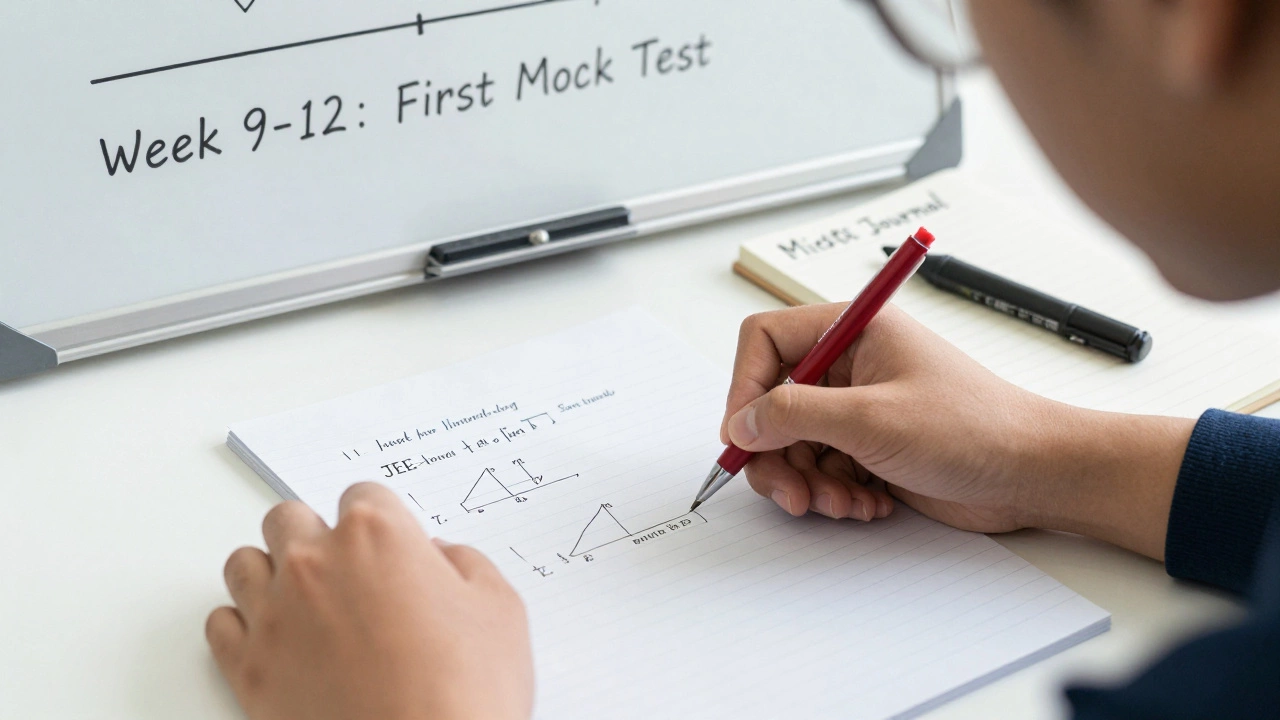
- Weeks 9-12: First mock test-Take a full JEE Main mock test (use NTA’s official sample papers). Don’t worry about your score. Focus on where you lost time, where you guessed, and which topics broke you.
After this, repeat the cycle every 3 months: learn → practice → test → analyze → improve.
The 5 mistakes self-studiers make (and how to avoid them)
Most people fail not because they’re not smart. They fail because they repeat the same errors:
- Mistake 1: Collecting too many resources. You don’t need 10 books on calculus. Stick to one core book and master it.
- Mistake 2: Studying without testing. Reading isn’t learning. Solving problems is. If you haven’t taken a timed test in two weeks, you’re falling behind.
- Mistake 3: Ignoring weak topics. You can’t say, “I hate electrostatics.” You need to tackle it. Spend 30 minutes daily on your weakest area until it becomes your strongest.
- Mistake 4: Not reviewing mistakes. Keep a mistake journal. Write down the problem, why you got it wrong, and the correct approach. Revisit it every Sunday.
- Mistake 5: Comparing yourself to coaching students. Their schedule isn’t yours. Focus on your progress, not their pace.
How to stay motivated when no one’s watching
You won’t have teachers checking your homework. No one will ask, “Did you finish the assignment?” So you need internal drivers.
Set micro-goals: “Today, I’ll solve 10 integration problems correctly.” Celebrate small wins. Track your streak-5 days in a row? 10? 30? That’s your momentum.
Join online forums like r/JEE on Reddit or Telegram groups of self-studiers. Read their stories. You’ll find people who started with 50% in Class 11 and cleared JEE Advanced. They didn’t have magic. They had consistency.
Visualize your goal. Write it on your wall: “I will get into IIT.” Not “I hope.” Not “Maybe.” “I will.”

What success looks like after 6 months
After six months of disciplined self-study, you should be able to:
- Solve 80% of JEE Main-level problems without help
- Complete a full mock test in 3 hours with 85% accuracy
- Identify your weak topics within 10 minutes of reviewing a test
- Stick to your study schedule for 20+ days straight
If you hit these marks, you’re on track. You don’t need coaching. You need to keep going.
When you should consider coaching
Self-study works for most. But coaching might help if:
- You’re struggling to understand core concepts even after 3 attempts with books and videos
- You’re isolated and lack accountability
- You’re preparing for JEE Advanced and need expert-level problem-solving techniques
Even then, don’t quit self-study. Use coaching as a supplement-not a replacement. Attend only the classes you need. Study the rest on your own.
Final truth: It’s not about talent. It’s about consistency.
There’s no secret formula. No hidden trick. The student who clears JEE without coaching isn’t smarter. They just showed up every day. They solved problems even when they didn’t feel like it. They reviewed their mistakes. They didn’t give up after a bad test.
If you’re serious about self-studying for JEE, you already have what it takes. The rest? It’s just daily action. Start today. Not tomorrow. Not after the holidays. Today.
Can I crack JEE Advanced without coaching?
Yes. Over 40% of JEE Advanced qualifiers in recent years were self-studiers. The key is mastering NCERT, solving past papers, and tracking mistakes daily. Coaching helps with structure, but not content-you can get the same material online or in books.
How many hours should I study daily for JEE self-study?
6-7 focused hours per day is enough. Quality matters more than quantity. Spend 4 hours on new topics and problem-solving, 2 hours on revision and mock tests, and 1 hour on weak areas. Avoid studying for 10+ hours without breaks-it leads to burnout and poor retention.
Is NCERT enough for JEE Main?
For Chemistry and Physics, NCERT covers 85-90% of JEE Main. For Math, it’s about 70%. You need additional practice books like H.C. Verma and R.D. Sharma to build speed and tackle tricky questions. But if you master NCERT thoroughly, you’re already ahead of 60% of coaching students.
What’s the best free resource for JEE self-study?
The NTA’s official JEE sample papers and previous years’ question papers are the best free resources. They show you exactly what’s tested. Pair them with YouTube channels like Physics Wallah and Unacademy JEE for concept clarity. Avoid watching too many videos-use them to fix gaps, not as your main study material.
Can I start self-studying for JEE in Class 12?
Yes, but you’ll need to work faster. Focus on completing Class 11 NCERT in the first 2 months, then move to Class 12. Prioritize high-weightage topics like Calculus, Electrodynamics, Organic Chemistry, and Thermodynamics. Take a mock test every two weeks to track progress. With 8-10 months of intense focus, clearing JEE Main is very possible.
How do I stay consistent without a study group?
Build a habit loop: study at the same time and place every day. Use a physical calendar to mark each day you study. Aim for a 21-day streak. Join online communities like Reddit’s r/JEE to share progress and get encouragement. Accountability doesn’t need to be in person-it just needs to exist.
If you’re reading this and thinking, “I can do this,” you already have what it takes. Start today. One problem. One chapter. One day at a time.