Curriculum Match Finder
Not sure which syllabus is right for your child? Answer these 4 questions to find your best fit.
Q1: Where do you plan to study for undergraduate degrees?
Q2: What is the primary goal of this education?
Q3: How would you describe your child's learning style?
Q4: Are you likely to move countries frequently during high school?
Your Recommended Curriculum
IB Diploma
Best for global mobility and holistic development.
Alternative Options
Ask ten parents which school board is superior, and you’ll get ten different answers. Some swear by the rigorous depth of the International Baccalaureate (IB) program, while others argue that the structured approach of the Central Board of Secondary Education (CBSE) is the only way to crack Indian competitive exams. The truth? There is no single "best" syllabus in the world. There is only the best syllabus for your specific goals, location, and learning style.
We need to stop treating curricula like sports teams with a fixed hierarchy. A curriculum is a tool. If you want to build a house, you don’t ask if a hammer is better than a screwdriver; you ask which one fits the job at hand. This article breaks down the major global players-CBSE, IB, IGCSE, and Advanced Placement (AP)-to help you decide which framework actually aligns with your child’s future.
The Myth of the Universal Gold Standard
First, let’s bust a myth: UNESCO or any other global body hasn’t declared a winner. Why? Because education systems are designed around local economic needs and cultural contexts. In Finland, the focus is on play-based learning with minimal testing. In Singapore, it’s about high-stakes proficiency in math and science. In India, the system has historically prioritized rote memorization followed by analytical application, though this is shifting.
When people search for the "best" syllabus, they are usually trying to solve one of three problems:
- University Admissions: Which board gives me the easiest path to Harvard, Oxford, or IIT?
- Career Flexibility: Can my child switch countries without restarting their education?
- Learning Style Fit: Does my child thrive on memorizing facts or solving open-ended problems?
Understanding these drivers is more important than chasing rankings. Let’s look at the heavy hitters.
CBSE: The Powerhouse for Competitive Exams
If you are in India or planning to enter the Indian higher education ecosystem, the CBSE syllabus is arguably the most pragmatic choice. It isn’t necessarily the "easiest," but it is tightly aligned with national entrance tests like JEE (engineering), NEET (medical), and UPSC (civil services).
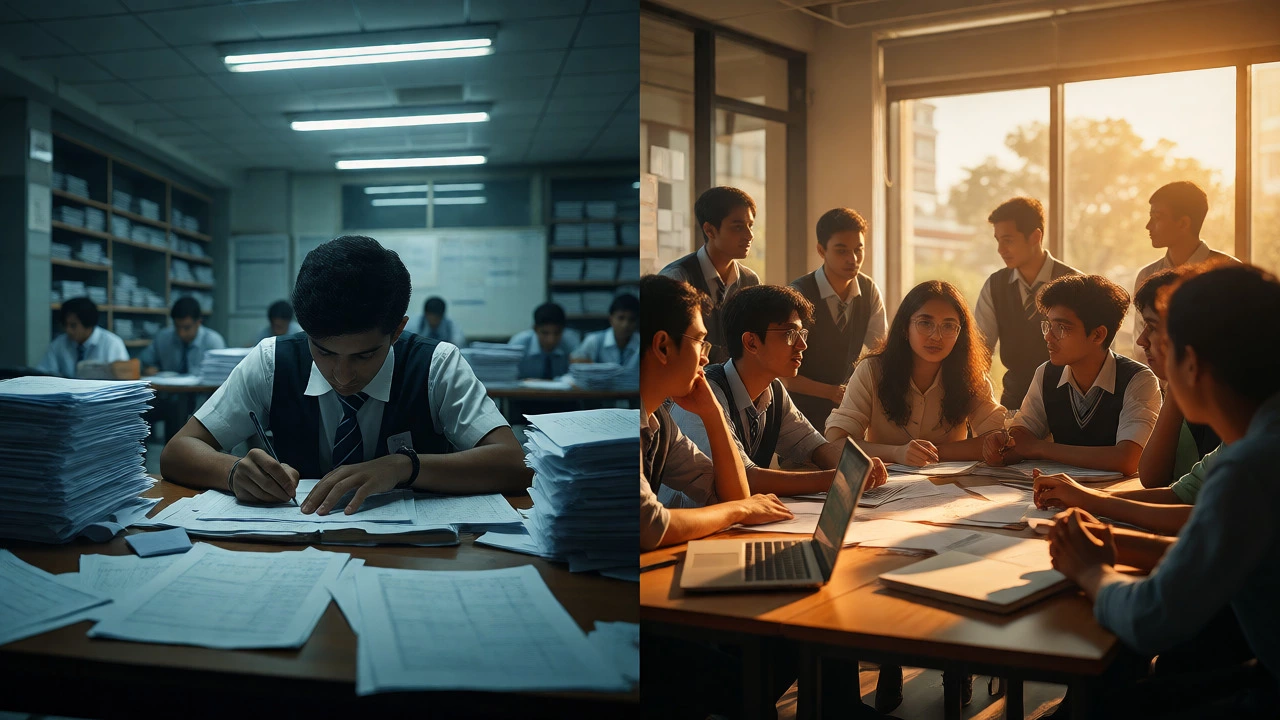
Why does this alignment matter? Because the question patterns in these exams mirror the CBSE curriculum’s emphasis on conceptual clarity within a defined scope. Students studying under international boards often find themselves needing extra coaching to bridge the gap between IB’s inquiry-based projects and the speed-accuracy demands of JEE.
| Attribute | CBSE | International Boards (IB/IGCSE) |
|---|---|---|
| Primary Focus | Conceptual depth in STEM & National Exams | Critical thinking, Research & Holistic growth |
| Assessment Method | 70% Written Exam + 30% Internal/Project | Mix of Coursework, Oral Exams, & Final Papers |
| Global Recognition | High in Commonwealth & Asia; Varies elsewhere | Universally recognized by top universities |
| Cost of Study | Low to Moderate | High (Private schools dominate) |
However, CBSE has its critics. The pressure cooker environment can stifle creativity. If your child struggles with standardized testing anxiety, the rigid structure might feel suffocating rather than supportive. But for students who thrive on clear benchmarks and structured revision, it offers a reliable roadmap.
IB: The Rigorous Challenge for Future Leaders
The International Baccalaureate (IB) Diploma Programme is often cited as the toughest academic challenge for high schoolers. And honestly? They’re right. The IB doesn’t just ask what you know; it asks how you think.
Key components like Theory of Knowledge (TOK) and the Extended Essay force students to write research papers and defend their viewpoints before university-level panels. This prepares them exceptionally well for liberal arts colleges in the US and UK, where independent thought is valued over regurgitated facts.
But here’s the catch: IB is expensive and time-consuming. The internal assessments require consistent effort throughout two years. You cannot cram for IB the night before an exam. If your family moves frequently or plans to study abroad immediately after high school, IB provides a passport to almost any university in the world. Its recognition is unmatched.
IGCSE and A-Levels: The British Tradition
For those preferring the British model, the Cambridge International Curriculum (IGCSE and A-Levels) offers a specialized pathway. Unlike IB, which requires breadth across six subjects, A-Levels allow students to specialize early. By age 16, a student might drop history entirely to focus solely on Physics, Chemistry, and Math.
This specialization is great for students who already know their career path. It’s less ideal for undecided teenagers. The assessment style is traditional-written exams carry significant weight-but the questions are known for their application-based nature. It’s a middle ground between the rote-heavy reputation of older Indian boards and the project-heavy nature of IB.
Advanced Placement (AP): The American Flexibility
While not a full syllabus replacement, Advanced Placement courses are often added to local curricula to boost college applications. Originating in the US, AP allows students to take college-level courses while still in high school. Passing an AP exam can earn college credit, saving time and money later.
Many private schools in India now offer "CBSE + AP" combinations. This hybrid approach lets students keep their local eligibility for JEE/NEET while adding a globally recognized credential to their resume. It’s a strategic move for families wanting both domestic safety and international prestige.

How to Choose: A Decision Framework
So, which syllabus wins? Use this simple decision tree:
- Are you staying in India for undergrad?
Choose CBSE. The alignment with entrance exams saves thousands of hours and dollars in coaching fees. - Is the goal US/UK Liberal Arts Universities?
Choose IB. The holistic profile appeals strongly to admissions officers at Ivy League and Russell Group universities. - Does the child have a clear specialization (e.g., Engineering)?
Consider A-Levels or CBSE + AP. Early specialization builds deep expertise. - Is the family highly mobile/expatriate?
Choose IB or IGCSE. These curricula are consistent worldwide, easing transitions between countries.
The Hidden Factor: Teacher Quality Over Syllabus
Here is a hard truth from experience: A mediocre teacher teaching the "best" IB curriculum will produce worse results than an excellent teacher teaching CBSE. The syllabus is just a map. The teacher is the guide.
When evaluating schools, don’t just look at the logo on the gate. Ask about teacher retention rates. Ask how they handle student mental health. Ask for examples of how they support struggling learners. A supportive environment beats a prestigious label every time.
Frequently Asked Questions
Is CBSE harder than IB?
It depends on the definition of "hard." CBSE is often considered more difficult in terms of volume of content and speed required for competitive exams like JEE. IB is considered harder due to the workload of continuous assessments, essays, and extracurricular requirements. CBSE tests memory and application under time pressure; IB tests research skills and critical analysis over two years.
Can I switch from CBSE to IB in Grade 11?
Yes, but it is challenging. The methodologies differ significantly. CBSE focuses on textbook mastery, while IB emphasizes inquiry-based learning. Students switching late often struggle with the Extended Essay and Internal Assessments because they haven't developed the research habits earlier. It is recommended to switch before Grade 11 if possible.
Which syllabus is best for medical aspirants in India?
CBSE is widely regarded as the best foundation for NEET preparation. The biology and chemistry concepts are taught in a sequence that mirrors the NCERT textbooks, which are the primary source for NEET questions. While IB students can crack NEET, they often need additional coaching to cover the specific factual details tested in the exam.
Do foreign universities accept CBSE marks directly?
Yes, most reputable universities accept CBSE Class 12 results. However, top-tier institutions may view CBSE scores with caution due to grade inflation concerns. To strengthen an application, CBSE students often supplement their grades with SAT/ACT scores or AP exams to provide a standardized benchmark for international admissions officers.
Is the ICSE board better than CBSE?
ICSE (Indian Certificate of Secondary Education) is often praised for its stronger emphasis on English language proficiency and literature compared to CBSE. However, ICSE has a larger syllabus volume, which can be overwhelming. For engineering/medical aspirants, CBSE remains the preferred choice due to better alignment with national entrance exams. For humanities or law aspirants, ICSE’s linguistic rigor can be a significant advantage.