
JEE Subject Priority Calculator
You sit down to study, and the clock is ticking. You have three massive subjects staring back at you: Physics, the study of matter and energy, Chemistry, the science of substances and their reactions, and Mathematics, the abstract science of number, quantity, and space. The question isn't just "which one do I like best?" It's "which one decides my rank?" If you are preparing for the IIT JEE, India's premier engineering entrance examination, every hour counts. You can't master all three equally in a short time. So, where do you put your energy?
The honest answer might surprise you. There is no single "most important" subject because the exam tests them differently. However, if we look at scoring potential, difficulty, and time management, a clear hierarchy emerges. This guide breaks down exactly how each subject impacts your final rank and which one you should prioritize based on your current strengths.
The Reality of JEE Mains and Advanced Scoring
To understand importance, you first need to understand the battlefield. The JEE Main, the primary screening test for IITs and JEE Advanced, the final selection test for IIT admissions are not just knowledge tests; they are speed and accuracy tests. Each subject carries equal weightage in terms of marks (100 marks per subject in JEE Main). But the effort-to-reward ratio varies wildly.
Many students fall into the trap of thinking that because Physics feels hardest, it must be the most important. Or because Chemistry requires memorization, it's the easiest to ignore. Both assumptions are dangerous. Let's look at what the data from recent years tells us about performance trends.
| Subject | Average Time Per Question | Scoring Consistency | Primary Skill Required |
|---|---|---|---|
| Physics | 3-5 minutes | Low (High variance) | Conceptual Application & Logic |
| Chemistry | 1-2 minutes | High (Predictable) | Memory & Quick Recall |
| Mathematics | 4-6 minutes | Medium (Lengthy steps) | Problem Solving & Calculation |
Why Mathematics Often Wins the "Most Important" Title
If you force a choice, Mathematics usually takes the crown for being the biggest rank booster-and the biggest rank killer. Why? Because it is the most calculative. In Physics, you can sometimes estimate an answer or use dimensional analysis to eliminate options. In Chemistry, you often know the reaction pathway by heart. In Math, you either have the solution or you don't. There is rarely a shortcut.
Mathematics questions in JEE Advanced tend to be longer and more complex. A single question might require five distinct steps of logical deduction. If you get stuck on step two, you lose four minutes and zero marks. This makes your speed and accuracy in Math critical. Students who excel in Math often secure the top percentile ranks because fewer students can solve these problems quickly under pressure.
However, this comes with a risk. If your foundation in Algebra or Calculus is weak, Math becomes a time sink. You cannot bluff your way through an integration problem. Therefore, Math is "most important" only if you have already built a strong base. If you are struggling with basic concepts, prioritizing Math without fixing those gaps will hurt your score more than help it.
The Underrated Power of Chemistry
Here is a secret that many toppers know: Chemistry is the subject that saves your rank. While Math and Physics determine your ceiling, Chemistry determines your floor. It is the fastest-scoring section. Organic Chemistry, Inorganic Chemistry, and Physical Chemistry offer a mix of logic and memory.
Inorganic Chemistry, for instance, is largely factual. If you have studied the NCERT textbook thoroughly, you can answer these questions in seconds. No long derivations, no complex calculations. Just recall. Physical Chemistry involves some math, but it is usually simpler than the calculus-heavy problems in Physics or Math sections. Organic Chemistry relies on mechanisms and patterns. Once you understand the electron flow, you can predict products without memorizing every single reaction.
Because Chemistry questions are quicker to solve, they free up time for the tougher Physics and Math problems. If you aim for a high rank, you should treat Chemistry as your "confidence builder." Securing 80-90% in Chemistry is realistic and achievable with consistent daily revision. Neglecting Chemistry to focus solely on "harder" subjects is a strategic error that costs thousands of ranks.
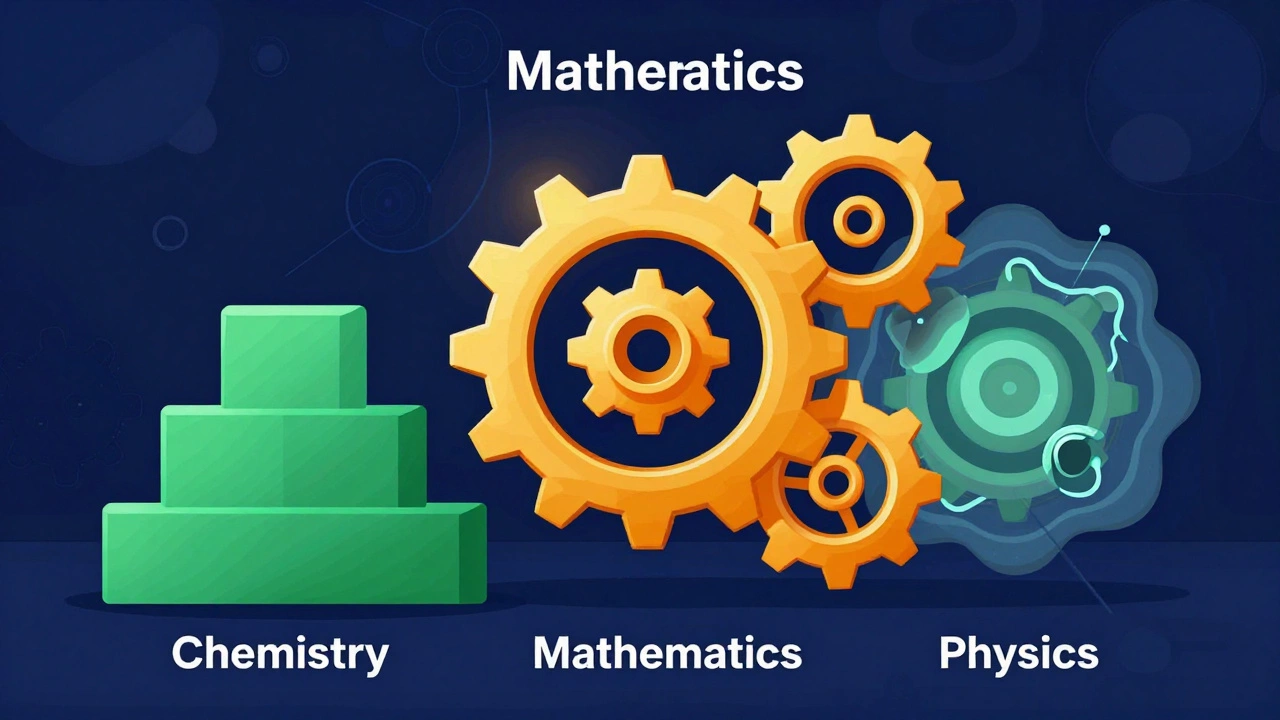
Physics: The Conceptual Gatekeeper
Physics is often considered the toughest because it bridges theory and application. You can memorize formulas, but if you don't understand the underlying physical principles, you will fail when the question twists the scenario. Mechanics, Electrodynamics, and Modern Physics require deep conceptual clarity.
Physics is "important" because it filters out students who rely purely on rote learning. In JEE Advanced, Physics questions often involve multiple concepts combined into a single problem. For example, a question might combine rotational motion with conservation of energy and friction. If you lack flexibility in applying concepts, Physics will drag your score down.
However, Physics has a unique advantage: it is often easier to guess correctly than Math. By analyzing units, limits, and symmetry, you can often eliminate wrong options even if you don't have the full solution. This makes Physics a slightly safer bet than Math if you are running out of time.
How to Prioritize Based on Your Profile
Since "importance" is subjective to your skills, you need a personalized strategy. Here is how to decide which subject deserves your extra hours right now:
- If you are a beginner (Class 11): Focus equally on all three. Build strong fundamentals in Physics concepts and Math basics. Don't rush into advanced problems yet.
- If you are average in all subjects: Prioritize Chemistry. It is the quickest way to boost your total score. Secure easy marks here before tackling complex Physics or Math problems.
- If you are strong in Math but weak in Physics: Keep maintaining your Math speed. Spend 60% of your extra time on Physics concepts. Use Math to keep your confidence high while you slowly improve Physics.
- If you are strong in Physics but weak in Math: This is a common profile. You need to practice Math daily. Start with shorter chapters like Matrices, Determinants, and Complex Numbers to build speed. Do not ignore Math because it feels slow; it will cap your rank.
The Synergy Strategy: Don't Silo Your Subjects
One mistake students make is studying each subject in isolation. But JEE loves interdisciplinary questions. Physics uses Calculus (Math) extensively. Chemistry uses Algebra and Logarithms (Math) in equilibrium problems. Math uses Trigonometry and Geometry, which are also tools in Physics.
When you study Integration in Math, immediately apply it to find work done in Physics. When you learn Equilibrium in Chemistry, practice the logarithmic calculations involved. This cross-pollination strengthens your understanding and saves time during the exam. You aren't just learning three subjects; you are learning one cohesive system of scientific reasoning.
Final Verdict: What Should You Do Today?
If you must pick one subject to start with today, pick the one you are weakest in-but only if it is not critically behind. If you are severely lacking in basics, start with Chemistry to build momentum. If you are balanced, rotate them daily. Do not skip any subject for more than two days. Consistency beats intensity. The "most important" subject is the one you neglect least.
Is Physics harder than Math in JEE?
It depends on your mindset. Physics is conceptually harder because it requires visualization and intuition. Math is procedurally harder because it requires precise calculation and multi-step logic. Many students find Math more frustrating due to time constraints, while others find Physics confusing due to abstract theories.
Can I crack JEE by focusing only on two subjects?
No. Ignoring one subject completely will limit your maximum possible score significantly. Even if you score 100% in two subjects, missing the third entirely will likely drop your rank below the cutoff for top IITs. You need a balanced approach across all three.
Which chapter in Chemistry is most important for JEE?
Organic Chemistry and General Chemistry (Inorganic) are crucial. Specifically, focus on Chemical Bonding, Thermodynamics, Electrochemistry, and Hydrocarbons. These chapters form the backbone of many other topics and frequently appear in exams.
How much time should I spend on each subject daily?
Aim for a balanced schedule. For example, if you study 8 hours, try spending 3 hours on Math, 3 hours on Physics, and 2 hours on Chemistry. Adjust this based on your weak areas. If Math is weak, increase its share gradually, but never drop Chemistry below 1-2 hours daily.
Does JEE Advanced have different weightage for subjects?
No, JEE Advanced also gives equal weightage to Physics, Chemistry, and Mathematics. However, the depth of questions in Advanced is greater, especially in Physics and Math. Chemistry remains relatively faster to solve, making it a key differentiator in time management.