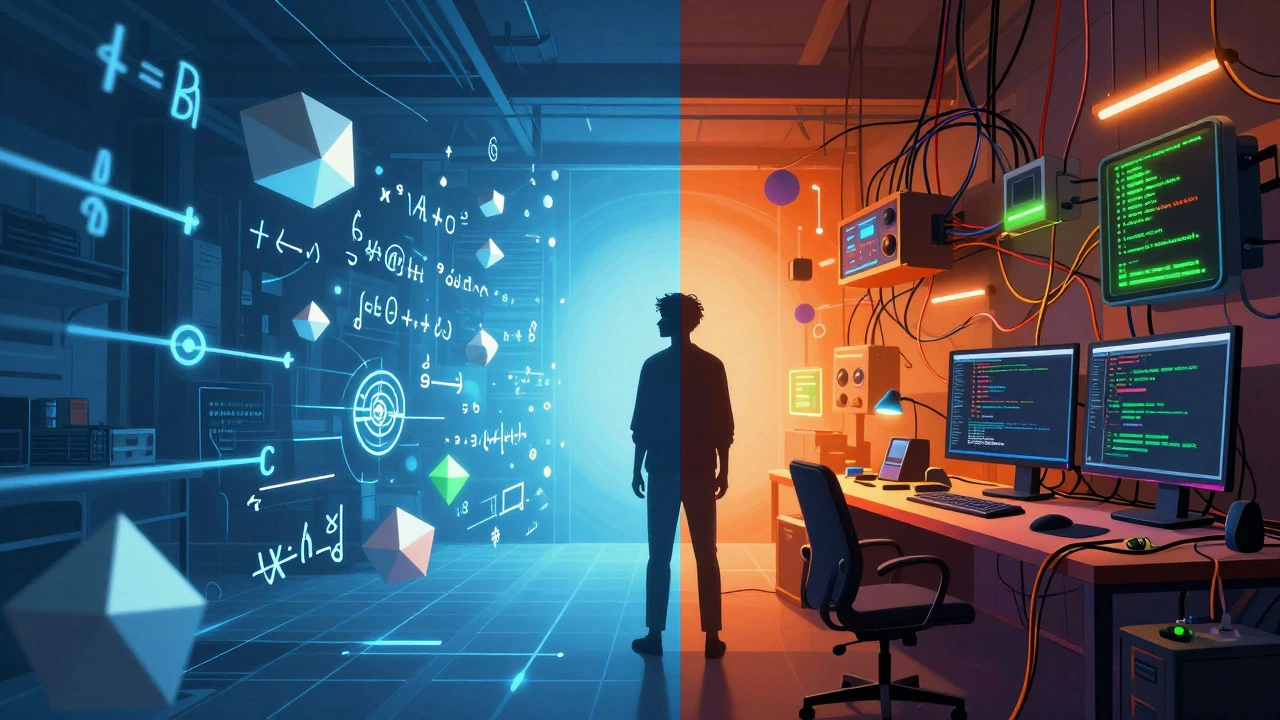
Coding vs. Math: Which is Harder for You?
Answer the following questions honestly to see which discipline aligns better with your natural strengths.
Ever sat down with a complex equation and felt your brain melt, only to open an IDE an hour later and feel like you’re speaking a foreign language? You aren’t alone. The debate over whether coding is the practice of writing instructions for computers using specific languages or mathematics is the abstract study of numbers, structure, space, and change is harder is one of the most common questions in tech education. It’s not just about which subject has more symbols; it’s about how your brain processes information.
The short answer? They are hard in completely different ways. Math demands abstract logical rigor and proof. Coding demands practical problem-solving, patience with syntax, and systems thinking. If you’ve ever wondered which path requires more grit, let’s break down the actual cognitive load, the types of frustration you’ll face, and why the "difficulty" often depends on your personal strengths rather than the subjects themselves.
The Nature of the Challenge: Abstract vs. Concrete
To understand why people struggle differently with these two fields, we have to look at what they actually ask of you. Mathematics, particularly at higher levels, is deeply abstract. When you study calculus or linear algebra, you are manipulating concepts that don't necessarily exist in the physical world. You are proving truths that hold regardless of context. This requires a high degree of logical reasoning is the process of drawing conclusions from premises using valid arguments.
Coding, on the other hand, is concrete but chaotic. You are building something tangible-a website, an app, a database. However, the environment is unforgiving. A single missing semicolon can crash your entire program. While math asks you to find the one correct answer, coding often asks you to find *a* working solution among millions of possibilities, while managing memory, user experience, and server loads simultaneously.
- Math Difficulty: High barrier to entry due to abstraction. Requires strong pattern recognition and symbolic manipulation skills.
- Coding Difficulty: Low barrier to entry (you can print "Hello World" in minutes), but a very high ceiling due to complexity management and debugging.
Why Math Feels Harder: The Abstraction Gap
For many students, math feels harder because there is no immediate feedback loop. You can spend hours on a proof, and if you miss one subtle step, the whole thing collapses. There is no compiler to tell you exactly where you went wrong. You have to rely on internal validation.
Consider Calculus is a branch of mathematics concerning continuous change. Understanding limits and derivatives requires visualizing infinity and infinitesimal changes. This is mentally taxing because it defies everyday intuition. If you don't "get" the concept intuitively, it’s very hard to brute-force your way through. Math rewards those who can hold multiple abstract variables in their head at once without losing track of the underlying rules.
Furthermore, math is cumulative in a strict hierarchy. If you didn't master fractions in elementary school, algebra will be a nightmare. If you struggled with algebra, trigonometry becomes impossible. There are few shortcuts. This creates a "gatekeeper" effect where early struggles make later topics feel insurmountably difficult.
Why Coding Feels Harder: The Complexity Trap
If math is hard because it’s abstract, coding is hard because it’s messy. Beginners often think coding is just typing commands. But professional software engineering is mostly debugging is the process of identifying and removing errors from computer programs. You might write ten lines of code and spend three hours figuring out why one variable isn’t updating correctly.
The frustration in coding comes from context switching. You need to know HTML for structure, CSS for style, JavaScript for behavior, and maybe SQL for data storage. Then you have to worry about how all these pieces talk to each other. This is known as systems thinking is an approach to understanding how parts interrelate within a whole system.
Imagine trying to build a house. Math is like calculating the exact angle of the roof beams. Coding is like actually laying the bricks, wiring the electricity, plumbing the pipes, and ensuring the doors open smoothly-all while dealing with a supplier who sends the wrong size nails. The volume of moving parts makes coding feel overwhelming, even if the individual concepts (like a loop or a function) are simpler than a differential equation.
Comparing Cognitive Loads: A Side-by-Side Look
To help you decide which might be harder for you, let’s compare the core challenges side by side. This table breaks down the mental muscles you’ll need to exercise.
| Challenge Area | Mathematics | Coding |
|---|---|---|
| Primary Skill | Abstract Logic & Proof | Problem Decomposition & Syntax |
| Feedback Loop | Slow (Self-validation or teacher review) | Fast (Compiler errors, runtime crashes) |
| Failure Mode | Conceptual misunderstanding | Syntax errors, logic bugs, integration issues |
| Learning Curve | Steep initial climb, then plateaus | Gentle start, exponential increase in complexity |
| Real-World Application | Theoretical foundations, finance, physics | Software development, automation, web apps |
The Role of Prior Knowledge and Mindset
Your background plays a huge role in perceived difficulty. If you grew up playing strategy games or puzzles, you might find coding easier because you’re already used to trial-and-error learning. If you excelled in science classes and loved deriving formulas, math might feel more natural.
There is also the issue of imposter syndrome is a psychological pattern where individuals doubt their accomplishments and fear being exposed as a fraud. In coding, imposter syndrome is rampant because technology changes so fast. New frameworks emerge every year. You can be an expert today and obsolete tomorrow. In math, the principles haven’t changed in centuries. Once you understand Pythagoras’ theorem, it doesn’t expire. This stability can make math feel safer, even if it’s intellectually tougher.
However, coding offers a sense of creation that math rarely does. Building a chatbot or a game gives you a dopamine hit that solving an integral might not. This emotional reward can mask the difficulty, making coding feel "easier" because you enjoy the process more.
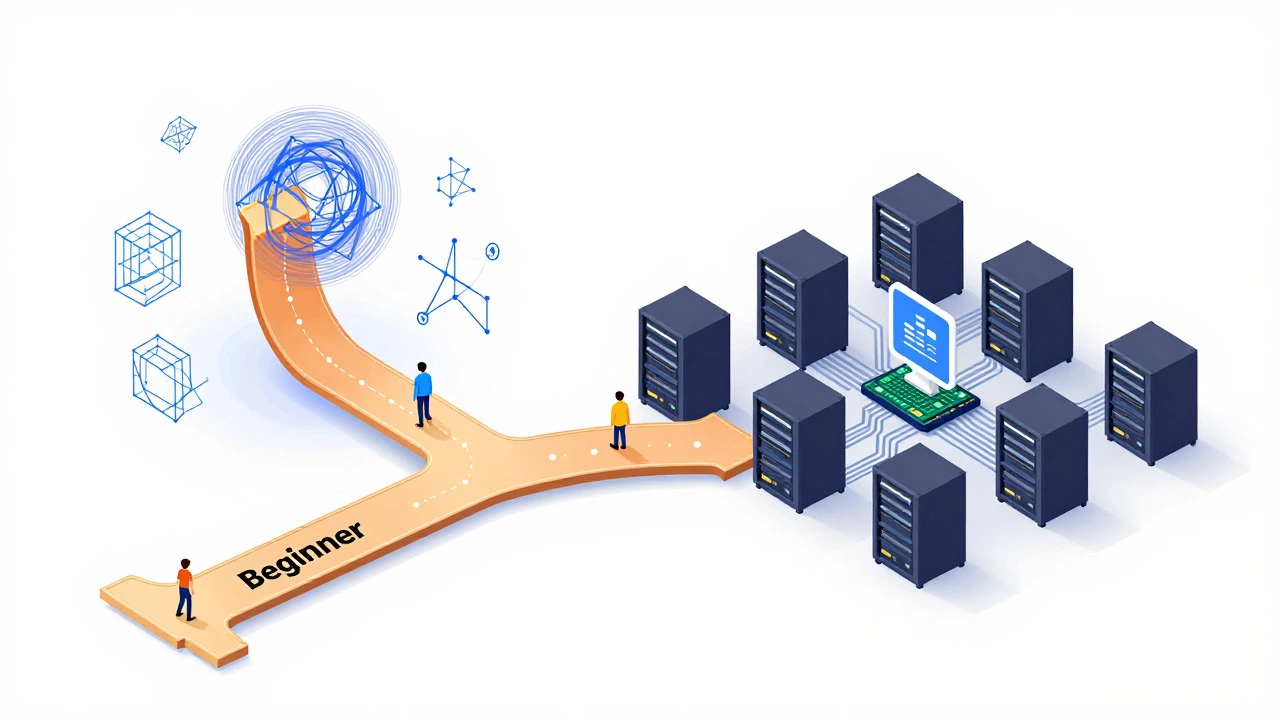
Which One Should You Learn First?
If you’re standing at the crossroads of education, wondering which skill to prioritize, here is a practical guide based on your goals.
- Choose Math if: You want to work in data science, artificial intelligence research, cryptography, or theoretical physics. These fields require deep mathematical literacy. You should focus on linear algebra, statistics, and probability.
- Choose Coding if: You want to build products, websites, or apps. You care more about functionality and user experience than underlying theory. Start with Python or JavaScript.
- Do Both if: You aim for a career in machine learning or quantitative finance. These roles sit at the intersection. You need enough math to understand the models and enough coding to implement them.
Don’t view them as competitors. They are tools. Math helps you think clearly; coding helps you act decisively. Many successful developers are terrible at advanced math, and many mathematicians can’t write a line of code. Both paths are valid.
Common Pitfalls to Avoid
Whether you pick math or coding, avoid these common traps that make either subject unnecessarily hard.
- Memorization over Understanding: Don’t memorize math formulas or coding syntax. Understand the why. If you know why a loop works, you don’t need to memorize the syntax-you can look it up.
- Isolation: Both fields are collaborative. Join coding communities like GitHub or Stack Overflow. Join math forums or study groups. Struggling alone is the fastest way to quit.
- Perfectionism: In coding, your first version will be bad. That’s normal. In math, your first attempt at a proof will likely fail. Iterate. Refactor. Revise.
Final Thoughts on Difficulty
So, is coding harder than math? Or is math harder than coding? The truth is, they are both hard because they demand discipline. Math tests your ability to think abstractly and precisely. Coding tests your ability to manage complexity and persist through failure.
If you hate ambiguity, math might feel harder because the answers aren’t always obvious. If you hate detail-oriented precision, coding might feel harder because a tiny typo breaks everything. Ultimately, the "harder" subject is the one that aligns less with your natural cognitive preferences. But with consistent practice, both become manageable-and even enjoyable-skills.
Is coding basically just applied math?
Not really. While coding uses basic arithmetic and some logic, most daily programming involves little more than middle-school math. The real challenge in coding is organization, architecture, and communication between systems, not calculation.
Can I learn to code if I’m bad at math?
Absolutely. Millions of successful programmers are not math experts. Unless you plan to work in graphics rendering, AI algorithms, or cryptography, you rarely need advanced math. Basic algebra and logical thinking are sufficient for most web and app development jobs.
Which pays more: math or coding careers?
Generally, specialized coding roles like software engineering and data science pay very well, often starting higher than pure mathematics roles. However, mathematicians in finance (quantitative analysts) or academia can earn significant incomes. The highest salaries usually go to those who combine both skills.
Is it harder to self-teach coding or math?
Self-teaching coding is generally easier because resources are abundant, interactive, and provide immediate feedback (your code runs or it doesn’t). Self-teaching advanced math is harder because it requires rigorous proofs and conceptual depth that are difficult to grasp without a mentor or structured curriculum.
Does knowing math make coding easier?
It helps with efficiency and algorithm optimization. A strong math background allows you to write cleaner, faster code by understanding time complexity and data structures better. However, it won’t help you with syntax, UI design, or debugging network requests.