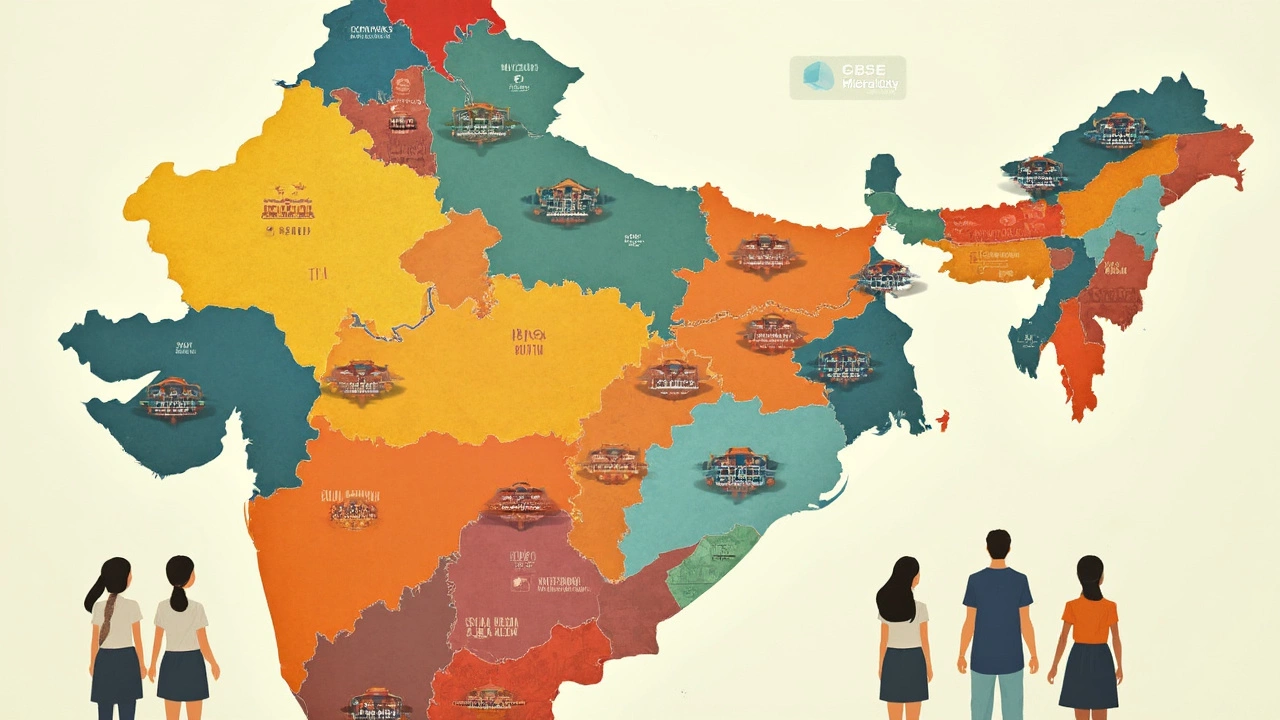
State-wise CBSE Comparison: How CBSE Stacks Up Across Indian States
When you hear CBSE, the Central Board of Secondary Education, India’s largest school board with over 20,000 affiliated schools. Also known as Central Board of Secondary Education, it governs curriculum, exams, and certification for millions of students from Delhi to Dibrugarh. But here’s the real question: does CBSE work the same way in Tamil Nadu as it does in Uttar Pradesh? The answer isn’t simple—and it’s not just about textbooks.
CBSE isn’t a one-size-fits-all system. While the syllabus is standardized nationwide, how it’s taught, how much weight it carries in college admissions, and even how parents perceive it changes drastically by state. In Maharashtra and Karnataka, where state boards like SSC and PUC dominate, CBSE is often seen as the ‘premium’ choice for families targeting JEE or NEET. In contrast, in states like West Bengal or Kerala, where state boards are deeply rooted in local culture and language, CBSE is still growing but faces resistance from educators who believe regional curricula build stronger foundational skills.
What makes CBSE stand out isn’t just its name—it’s the JEE, the Joint Entrance Examination for engineering, the gateway to IITs and NITs and NEET, the National Eligibility cum Entrance Test for medical colleges. These exams are designed around CBSE’s NCERT-based content. That’s why even in states with strong local boards, parents pull their kids out of state schools to join CBSE-affiliated ones by Class 8. Why? Because the jump from state syllabus to NEET/JEE is brutal. CBSE students don’t have to unlearn anything—they’re already speaking the exam’s language.
But CBSE isn’t perfect. In rural Rajasthan or Odisha, many CBSE schools struggle with teacher training and lab access. Meanwhile, state boards in Gujarat or Andhra Pradesh have improved dramatically, offering better practical exposure and local language support. So the real comparison isn’t CBSE vs. state boards—it’s CBSE vs. the quality of the school, regardless of board. A well-run state school in Telangana might outperform a poorly managed CBSE school in Bihar.
And here’s the quiet truth: no one chooses CBSE because it’s easier. They choose it because it’s predictable. The exam patterns, the weightage of chapters, the way questions are framed—it’s all consistent. In contrast, state boards vary wildly. One year, a Tamil Nadu board might focus on 15-mark questions from a single chapter. The next year, it’s all application-based. That uncertainty scares parents. CBSE doesn’t surprise you. It prepares you.
What you’ll find in the posts below isn’t just a list of differences. It’s a breakdown of what actually matters when you’re choosing a board for your child—or for your own coaching strategy. You’ll see how CBSE compares to ICSE, why it dominates in North India, and how even state boards are starting to copy its exam structure. You’ll also learn why Chemistry is the most scoring subject in JEE, how coaching centers exploit CBSE’s syllabus, and why skipping Physical Chemistry is a gamble most students can’t afford. This isn’t theory. It’s what’s happening in classrooms from Mumbai to Manipur right now.
Which State Has More CBSE Schools in India? Key Facts You Should Know
May, 18 2025
Curious about where CBSE schools are most common in India? This article pinpoints which state leads the count, gives interesting facts about why that’s the case, and shares tips for navigating the CBSE network as a parent or student. We break down real numbers, share practical reasons behind these trends, and make it easy to compare states. You'll also discover what makes CBSE school distribution unique and how it can affect student choices. Dive in if you want to get serious about CBSE schooling options across India.