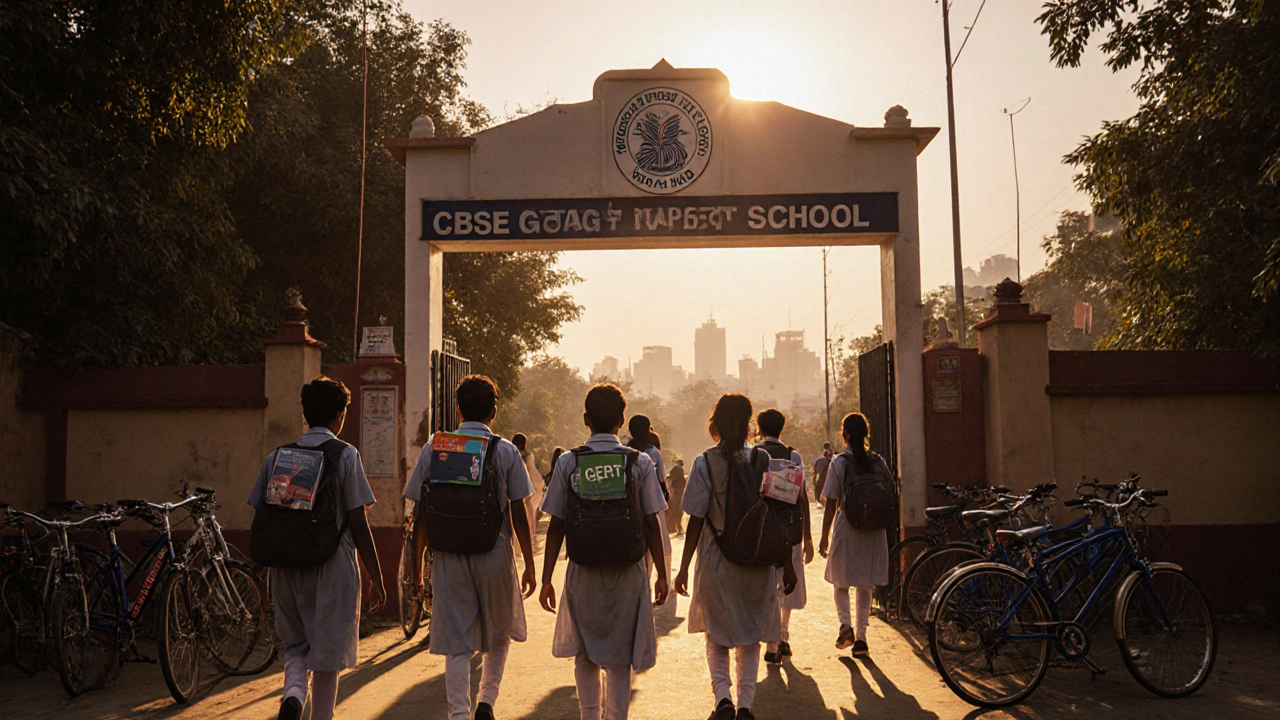
CBSE vs ICSE: Which Board Is Right for Your Child’s Chemistry Success?
When it comes to school boards in India, CBSE, the Central Board of Secondary Education, is the most widely followed board with a focus on standardized testing and national exams like JEE and NEET and ICSE, the Indian Certificate of Secondary Education, known for its detailed syllabus, emphasis on English, and deeper conceptual understanding are the two biggest names. Most parents ask: which one gives their child the best shot at top scores in chemistry? It’s not about which is "better" — it’s about which fits your child’s goals, learning style, and future path.
CBSE is designed with competitive exams in mind. Its chemistry syllabus is leaner, more predictable, and closely aligned with NCERT textbooks — the exact source of 80% of JEE Main and NEET questions. If your child is aiming for medical or engineering college, CBSE gives them a direct highway. On the flip side, ICSE dives deeper into theory, practical applications, and language-heavy explanations. Their chemistry papers test not just memory but reasoning — students need to explain why a reaction happens, not just write the equation. That’s great for critical thinking, but it can feel overwhelming if your child is racing against JEE’s tight clock.
Here’s the real difference: CBSE vs ICSE isn’t just about textbooks — it’s about time. CBSE lets you cover more ground faster. ICSE makes you dig deeper into each topic. If your child thrives on structure and wants to maximize marks per hour studied, CBSE wins. If they love asking "why?" and want to build a rock-solid foundation for college-level science, ICSE delivers. But here’s the catch: many ICSE students end up switching to NCERT-heavy prep for JEE/NEET anyway. That’s why so many parents we’ve talked to choose CBSE — not because it’s easier, but because it’s smarter for the end goal.
And if you’re wondering about difficulty, don’t believe the myth that ICSE is "tougher." It’s just different. ICSE has more chapters, longer papers, and heavier writing. CBSE has fewer chapters but higher stakes — one wrong mechanism in organic chemistry can cost you 5 marks. Both boards test the same core topics: chemical bonding, thermodynamics, electrochemistry, and organic reactions. The difference is in how they ask the questions. CBSE wants the right answer fast. ICSE wants you to show your thinking.
What you’ll find below are real, practical breakdowns from students and teachers who’ve walked both paths. We’ve pulled together posts that compare syllabus weightage, reveal which chapters trip up students on each board, show how coaching materials differ, and even break down why chemistry is the most scoring subject in JEE — no matter which board you’re on. Whether you’re choosing a school, switching boards, or just trying to get your child’s chemistry scores up, these insights cut through the noise. No fluff. Just what works.
Which School Board Is Most Popular in India? CBSE Explained
Nov, 21 2025
CBSE is the most popular school board in India, preferred by millions for its exam-focused syllabus, alignment with JEE and NEET, and nationwide recognition. Learn why it dominates over ICSE and state boards.
Understanding the Validity of ICSE in the USA: What You Need to Know
Apr, 14 2025
The ICSE board is known for its comprehensive curriculum, but is it valid in the USA? This article explores the acceptance of ICSE certificates by American institutions, explaining how ICSE compares with other boards like CBSE. We also provide insights into the recognition process and offer practical tips for students planning to study in the USA. Discover what you need to know about transferring credits and understanding equivalency.