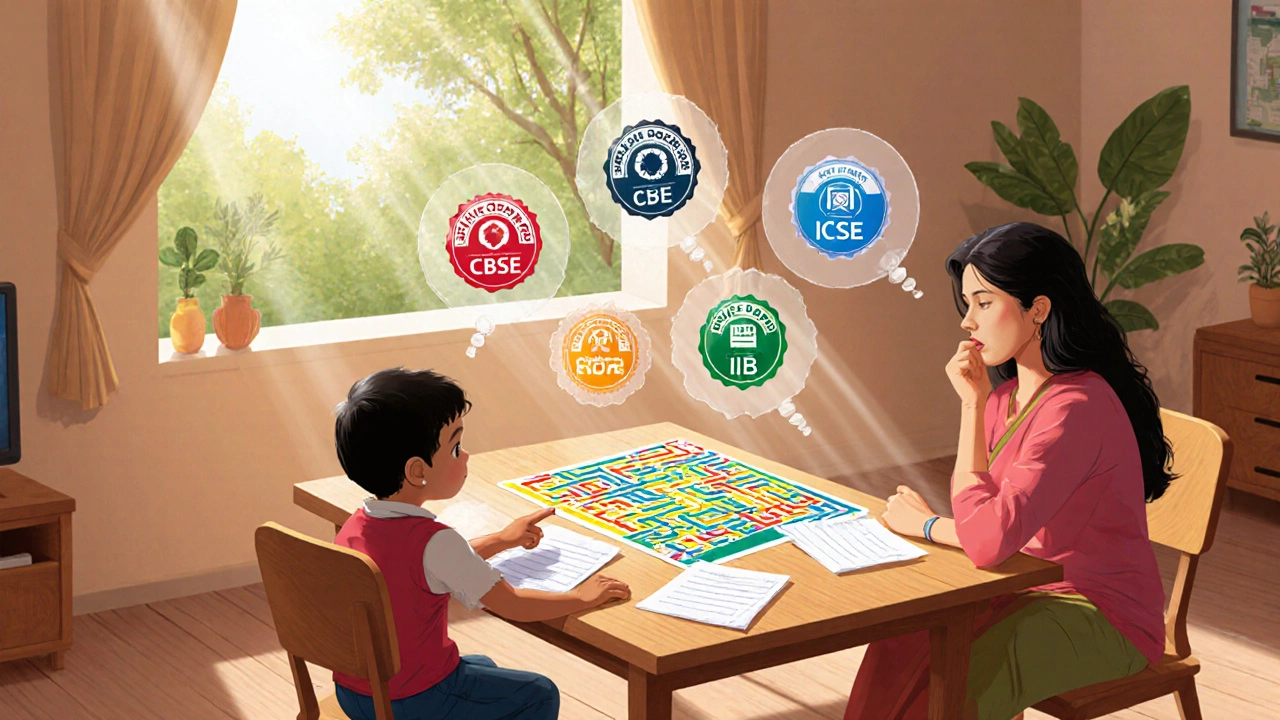
Best CBSE Syllabus for Kids in 2025: A Complete Guide for Parents
Discover which syllabus fits your child best in 2025. Compare CBSE, ICSE, state boards, IB and CAIE, learn key criteria, and get a practical checklist for parents.
When it comes to the best syllabus for kids, a structured, clear, and age-appropriate learning framework designed for young students. Also known as a child-friendly curriculum, it’s not about how much they learn—but how well they understand it. In India, this isn’t just a theoretical question. Millions of parents and teachers are choosing between CBSE, ICSE, and state boards every year, and the decision shapes how kids see science, math, and even language for years to come.
The CBSE syllabus, a national curriculum focused on clarity, exam readiness, and progressive learning from Class 1 to 12. Also known as Central Board of Secondary Education, it’s the most popular choice for a reason: it avoids overload in early grades, uses simple language, and builds concepts step by step. Unlike ICSE, which dives deep into theory early on, CBSE keeps things practical. Think of it like teaching a kid to ride a bike—you don’t start with the engine specs. You let them balance first. That’s what CBSE does with chemistry, biology, and even English. It’s why over 20 million students in India follow it. Meanwhile, the ICSE syllabus, a more detailed, literature-heavy curriculum often seen as academically rigorous. Also known as Indian Certificate of Secondary Education, it’s great for kids who love reading and asking ‘why?’ But for younger learners, the volume of text and abstract concepts can feel overwhelming. A 7-year-old doesn’t need to memorize poetic devices in English—they need to learn how to tell a story. That’s where CBSE wins for early years.
State boards vary wildly. Some are too relaxed, others too rigid. But here’s the truth: no syllabus is perfect for every child. The best syllabus for kids is the one that matches their pace, their curiosity, and their future goals. If your child might take JEE or NEET later, CBSE gives them a head start. If they thrive on discussion and creativity, ICSE might suit them better by Class 6 or 7. But for ages 5 to 10? Simplicity wins. Clear lessons. Fewer textbooks. More hands-on learning. Less pressure. That’s what the top-performing schools in India are doing—and it’s backed by data from thousands of students who moved from state boards to CBSE and saw their confidence climb.
What you’ll find below are real insights from posts that have helped parents and teachers make sense of this mess. We’ve pulled together what actually works—not what’s advertised on billboards. From why CBSE dominates Indian schools to how early exposure to science topics sets kids up for success, you’ll see the patterns that matter. No fluff. No marketing. Just what the data and real families are seeing on the ground.
Discover which syllabus fits your child best in 2025. Compare CBSE, ICSE, state boards, IB and CAIE, learn key criteria, and get a practical checklist for parents.