Coding vs. Programming Proficiency Quiz
This tool helps you identify whether a task requires simple coding (translating instructions) or complex programming (designing solutions). Select the best approach for each scenario.
Your application crashes because a semicolon is missing at the end of line 42. What is the primary skill needed to fix this?
Users report that uploading large files causes the server to run out of memory. The code runs without errors, but the system fails under load. How should you address this?
You need to store user tasks. You have 10,000 items and need instant retrieval by ID. Should you use an Array or a Hash Map? This decision relies primarily on:
You are setting up a new environment and just want to verify it works by printing text to the console. This is primarily a test of:
According to the article, which skill set makes a developer more resilient to automation by AI tools like GitHub Copilot?
Quiz Results
Score: 0 / 5
Answer all questions to see your proficiency assessment.
You’ve probably seen job postings that ask for "coding skills" and others that demand "programming expertise." It’s confusing, right? Are they the same thing? If you’re thinking about signing up for coding classes, does it matter which word is in the title? Here is the truth: while people use them interchangeably in casual conversation, they are distinct disciplines. One is about typing syntax; the other is about solving problems. Understanding this difference could save you months of frustration and help you pick the right learning path.
The Core Difference: Syntax vs. Logic
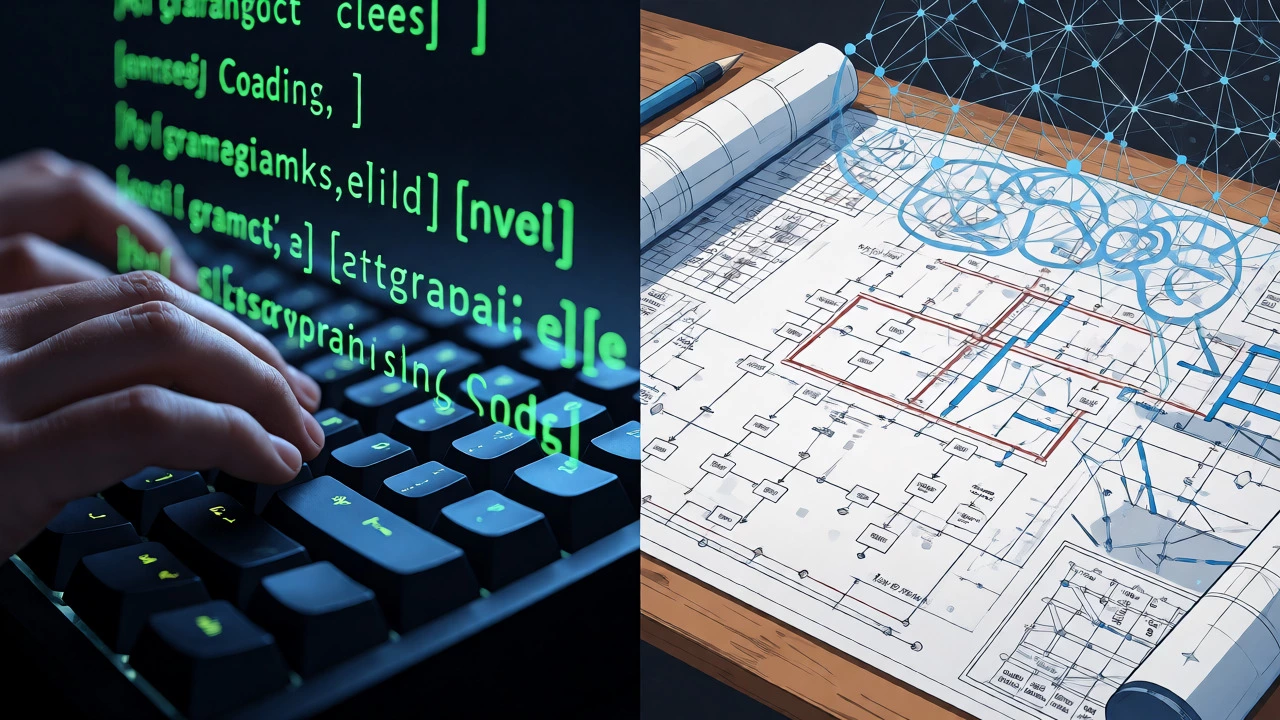
Think of it like writing a novel. Coding is the act of typing the words. It involves knowing grammar, spelling, and punctuation. In tech terms, coding is translating human instructions into a language a machine understands, like Python or JavaScript. It’s mechanical. You follow rules. If you miss a semicolon, the code breaks. That’s it.
Programming is the plot, character development, and theme. It’s the broader process of designing a solution before you write a single line of code. Programming involves algorithm design, data structure selection, system architecture, and debugging logic. It requires critical thinking, not just typing speed.
If coding is building a brick wall, programming is being the architect who decides where the wall goes, how high it should be, and whether it needs reinforcement against earthquakes. You can’t have good programming without coding, but you can write terrible code with great programming intentions if your syntax skills are weak.
Why This Distinction Matters for Beginners
Many beginners rush into learning syntax-memorizing loops and variables-without understanding why they exist. They end up with "spaghetti code": functional but messy, hard to read, and impossible to maintain. This happens when you focus on coding (the output) rather than programming (the thought process).
Consider a simple task: sorting a list of names. A coder might just find a built-in function and call it. A programmer thinks: "Is this list huge? Do I need memory efficiency? Should I use QuickSort or MergeSort based on the data distribution?" The coder gets the result. The programmer builds a scalable solution.
If you only learn to code, you become a translator. If you learn to program, you become an engineer. Translators are replaceable by AI tools. Engineers who understand system design are not.
Which One Should You Start With?
Here is the controversial part: you don’t really choose. You do both simultaneously. But your focus changes depending on your stage.
- Stage 1: The Coder Phase. When you start, you need to get comfortable with the keyboard and syntax. You are learning the "grammar." At this point, taking structured coding classes helps because they force you to practice repetitive tasks until muscle memory kicks in. You aren’t worrying about scalability yet; you’re worrying about getting the code to run without errors.
- Stage 2: The Programmer Phase. Once you can write basic scripts, you shift focus to logic. You start asking, "What is the most efficient way to solve this?" You learn about time complexity, memory management, and design patterns. This is where self-study often fails because it lacks mentorship on best practices.
Most online tutorials teach you to code. They show you how to make a button click print "Hello World." Few teach you to program. They rarely explain why we use arrays instead of linked lists in specific scenarios. That gap is where many learners stall.

Comparing Learning Paths
Let’s look at what different educational approaches actually deliver. This table breaks down the typical outcomes of focusing on one side over the other.
| Feature | Coding-Focused Learning | Programming-Focused Learning |
|---|---|---|
| Primary Skill | Syntax mastery, library usage | Algorithmic thinking, system design |
| Time to First Job | Faster (3-6 months) | Slower (6-12 months) |
| Job Role Fit | Junior Developer, QA Tester | Software Engineer, Architect |
| AI Resilience | Low (easily automated) | High (requires judgment) |
| Common Pitfall | Writing inefficient code | Over-engineering simple problems |
Notice the "AI Resilience" row. Tools like GitHub Copilot are excellent coders. They predict syntax perfectly. But they struggle with complex architectural decisions. If you only learn to type code, you compete with a free AI tool. If you learn to program, you direct the AI.
The Role of Coding Classes in Modern Education
Since you mentioned coding classes, let’s address their value. Not all classes are created equal. Some are pure "syntax drills." Others teach problem-solving frameworks.
Look for classes that emphasize computational thinking. This is the bridge between coding and programming. It involves decomposition (breaking big problems into small ones), pattern recognition, abstraction, and algorithm design.
A good coding class will give you a project like "Build a To-Do List." A bad one says "Type this code." A great one asks, "How would you store these tasks so they load instantly even if there are 10,000 of them?" That question forces you to think like a programmer, not just a typist.
In Toronto’s tech scene, employers increasingly screen for logical reasoning tests alongside technical interviews. Knowing syntax won’t pass those tests. Understanding recursion and data structures will.

Real-World Scenario: The Bug Hunt
Imagine your app crashes when users upload large files. A coder looks at the error log and fixes the syntax causing the crash. Done. A programmer investigates deeper. They realize the server runs out of memory because the entire file loads into RAM. They rewrite the upload process to stream chunks of data. The coder fixed the symptom. The programmer solved the disease.
This is why senior developers spend more time reading code and designing systems than typing new lines. Their value lies in their programming mindset, not their coding speed.
How to Balance Both While Learning
You don’t need to choose one forever. Here is a practical roadmap:
- Pick a Language: Python is great for beginners because its syntax reads like English. JavaScript is essential for web work. Pick one and stick to it for six months.
- Master the Syntax: Spend the first month doing coding exercises. Use platforms that provide instant feedback. Get comfortable making mistakes and fixing them.
- Introduce Logic Puzzles: Start solving problems on sites like LeetCode or HackerRank. These focus on algorithms, not syntax. You’ll be forced to think programmatically.
- Build Small Projects: Don’t just copy tutorials. Build something unique. Maybe a personal budget tracker. Encounter real-world constraints. Decide how to store data. Handle edge cases. This blends coding and programming.
- Refactor Your Code: Go back to old projects. Can you make them cleaner? More efficient? This teaches you that code is written once but read many times.
Conclusion: It’s a Spectrum, Not a Choice
Stop worrying about whether you’re "learning programming" or "learning coding." You’re learning to build software. Early on, you’ll spend 80% of your time on coding mechanics. Later, that ratio flips to 80% programming strategy.
If you join coding classes, ensure they challenge your brain, not just your fingers. Ask instructors: "Will we cover data structures and algorithms?" If the answer is no, you’re just learning to type in a foreign language. You want to learn to speak it fluently.
Is coding harder than programming?
Coding is generally considered easier to start because it involves memorizing syntax and following strict rules. Programming is harder because it requires abstract thinking, creativity, and complex problem-solving. However, advanced coding (like optimizing low-level memory) can also be very difficult.
Can I get a job knowing only coding?
Yes, especially for junior roles. Many entry-level jobs require you to implement designs created by senior engineers. However, career growth stagnates if you don’t develop programming skills (system design, optimization). You risk being replaced by automation tools that handle routine coding tasks well.
Which language is better for learning programming concepts?
Python is often recommended because its simple syntax lets you focus on logic rather than fighting with braces and semicolons. Java is another strong option because its strict structure forces you to understand object-oriented programming principles early on.
Do coding bootcamps teach programming or just coding?
It varies. Most bootcamps are intensive coding programs focused on getting you job-ready quickly. They often skim over deep computer science theory. Look for bootcamps that include modules on data structures, algorithms, and system design to ensure you gain programming skills too.
Does AI make learning to code obsolete?
No, but it changes the skill set. AI handles syntax generation well. Human programmers are still needed to define requirements, debug complex interactions, and design secure, scalable architectures. The role shifts from writer to editor and architect.