
Python Learning Roadmap Estimator
Configure Your Plan
Estimated Time to Proficiency:
Your Learning Path
Select your goals and available time to see a personalized roadmap.
Picture this: You sit down at your computer, determined to finally learn how to code. You open a tutorial, see a wall of curly braces, semicolons, and cryptic syntax, and close the tab five minutes later. Now imagine opening another tutorial where the code looks almost like plain English. That second experience is Python, which is a high-level programming language designed for readability and simplicity. It has become the go-to starting point for millions of learners worldwide because it removes the friction between having an idea and writing the code to make it happen.
But here is the real question that keeps popping up in forums and classrooms: Is Python actually easy to learn? The short answer is yes, but with a massive asterisk. The language itself is forgiving, but the concepts behind programming are universal. If you expect to master software engineering in a weekend, you will be disappointed. If you want to build a functional script or automate a boring task within a month, you are in luck. Let’s break down why Python feels easier than other languages, where the hidden traps lie, and how you can actually stick with it when things get tough.
Why Python Feels Like Reading English
The biggest reason people say Python is easy is its syntax. Most traditional programming languages, like C++ or Java, force you to manage memory manually and write boilerplate code just to print "Hello World." In those languages, missing a single semicolon stops everything from running. It feels like arguing with the machine.
In Python, the machine does most of the heavy lifting. You don’t need to declare variable types. You don’t need curly braces to define blocks of code; you just use indentation. This forces clean, readable code by design. When you read a Python script, you aren’t deciphering symbols; you are following logic. For example, a loop in Python reads like a sentence: "For each item in the list, do this." This natural mapping reduces cognitive load, allowing beginners to focus on problem-solving rather than memorizing syntax rules.
This readability isn’t just a gimmick. It lowers the barrier to entry significantly. According to data from major coding bootcamps and online platforms, students who start with Python complete their first project 30% faster on average compared to those starting with JavaScript or C#. That early win is crucial for motivation. When you see results quickly, you keep going.
The Hidden Complexity: Logic vs. Syntax
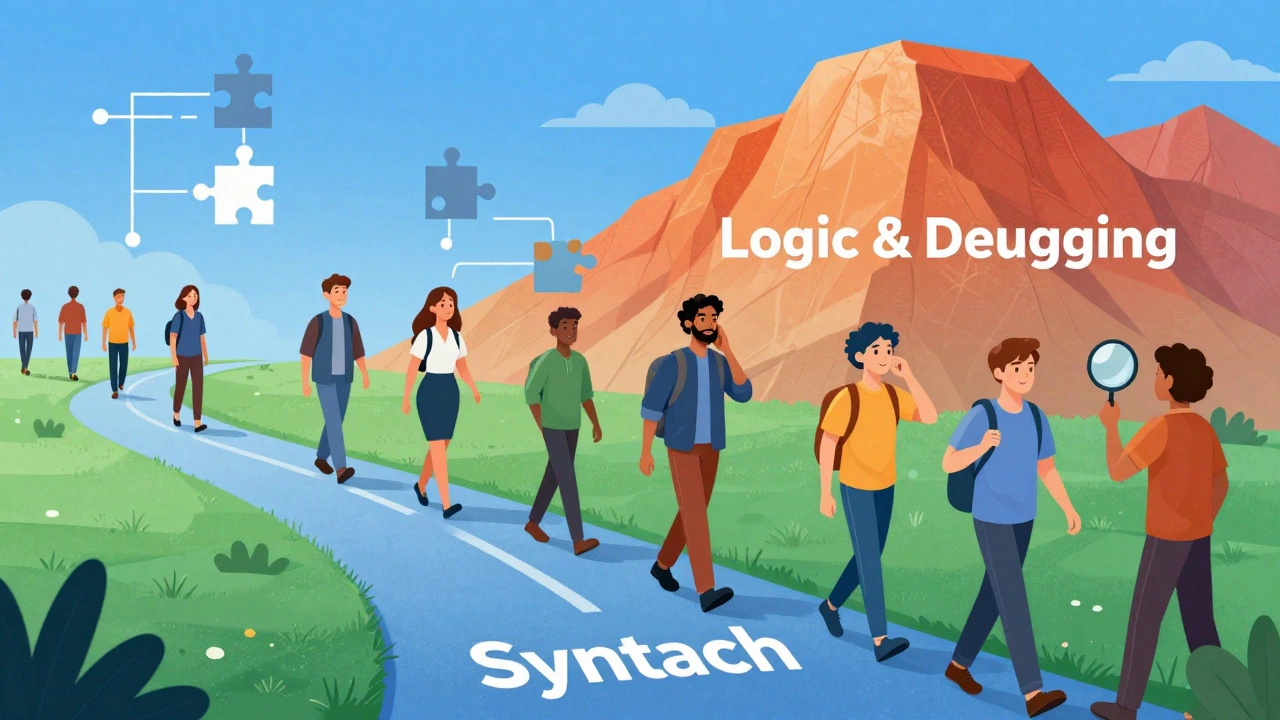
Here is where the "easy" label gets tricky. Learning Python syntax is like learning the alphabet. Learning to program is like learning to write poetry. Just because you know the letters doesn’t mean you can structure a complex argument or debug a logical error.
New learners often hit a wall after two weeks. They understand loops and variables, but they struggle with object-oriented programming (OOP), recursion, or understanding why their function returns `None` instead of the expected value. These aren’t Python-specific problems; they are fundamental computer science concepts. Every language has them. Python hides some of the complexity, but it doesn’t remove the need to think logically.
Consider debugging. In Python, errors can sometimes be vague if you are working with large libraries. You might spend hours chasing a bug only to realize you passed a string where an integer was expected. This frustration is part of the process. It teaches you attention to detail and systematic thinking. The ease of Python means you spend less time fighting the compiler and more time wrestling with your own logic. That is a good trade-off, but it requires patience.
Python vs. Other Beginner Languages
To truly understand if Python is right for you, it helps to compare it with other popular entry points. Each language serves a different purpose and offers a different learning curve.
| Language | Primary Use Case | Learning Curve | Best For |
|---|---|---|---|
| Python | Data Science, AI, Backend Web | Low (Syntax) / Medium (Logic) | Generalists, Data Enthusiasts |
| JavaScript | Frontend Web Development | Medium | Visual Learners, Web Designers |
| Java | Enterprise Apps, Android | High | Structured Thinkers, Corporate Careers |
| C++ | Game Dev, System Software | Very High | Performance-Obsessed Engineers |
JavaScript is often cited as a competitor to Python for beginners. The advantage of JavaScript is immediate visual feedback. You change a line of code, refresh your browser, and see the button move. Python runs in the background. Unless you connect it to a web framework or a graphical interface, you are looking at text output. If you are a visual person, JavaScript might feel more rewarding initially. However, JavaScript has quirks-like its type coercion system-that can confuse beginners in subtle ways. Python is stricter and more predictable, which builds better habits early on.
Java and C++ are steeper climbs. They require you to understand memory management, compilation processes, and strict typing. While they teach deep foundational knowledge, they often burn out hobbyists before they build anything fun. Python strikes a balance: it is powerful enough for professional jobs but simple enough for weekend projects.
The Role of Community and Resources
A language is only as easy to learn as its support system. Python has one of the largest, most active communities in the world. This matters immensely. When you get stuck-and you will-you are never alone. Stack Overflow has thousands of answers to every common Python error. YouTube has countless tutorials ranging from five-minute tips to full university courses.
Libraries also play a huge role. In many languages, building a feature from scratch takes days. In Python, you can import a library that already does what you need. Want to scrape a website? Use `BeautifulSoup`. Want to analyze data? Use `Pandas`. Want to build a neural network? Use `TensorFlow`. This "batteries-included" ecosystem means you can achieve complex goals with minimal code. It creates a sense of competence quickly. You aren’t just learning to code; you are learning to leverage existing tools. This is a critical skill in modern development.
However, reliance on libraries can be a double-edged sword. Beginners sometimes copy-paste code without understanding how it works. This leads to fragile programs that break easily. To avoid this, treat libraries as black boxes only until you are ready to peek inside. Read the documentation. Understand the inputs and outputs. This habit separates casual coders from competent developers.
Realistic Timeline: What Can You Actually Build?
Expectations kill progress. If you think you will build the next Facebook in three months, you will quit. But if you aim for small, tangible wins, you will succeed. Here is a realistic roadmap for a beginner dedicating 5-10 hours a week to learning Python.
- Weeks 1-4: Master the basics. Variables, data types, conditionals, loops, and functions. Build simple command-line tools like a calculator, a number guessing game, or a unit converter.
- Months 2-3: Dive into data structures. Lists, dictionaries, sets, and tuples. Start using external libraries. Build a script that automates file renaming, scrapes headlines from a news site, or analyzes a CSV file of your expenses.
- Months 4-6: Explore specialization. Choose a path: web development with Flask or Django, data analysis with Pandas, or automation with Selenium. Build a portfolio project. A personal blog, a weather dashboard, or a bot that sends daily emails.
By the end of six months, you won’t be a senior engineer, but you will be employable for junior roles or capable of solving real-world problems efficiently. The key is consistency. Coding is a muscle. You have to use it regularly to stay strong. Missing a week is fine. Missing a month resets your progress.
Pitfalls to Avoid When Starting Out
Even with an easy language, beginners make mistakes that stall their growth. Here are the most common traps and how to sidestep them.
Tutorial Hell: This happens when you watch video after video without typing code yourself. You feel like you are learning, but you aren’t. Your brain recognizes the pattern, but your hands don’t know the execution. Break the cycle. After every tutorial, pause and rebuild the project from scratch without looking at the video. Then, add a new feature on your own.
Ignoring Errors: Python error messages are helpful. They tell you exactly which line failed and why. Don’t skim past them. Read them. Search for them. Understanding an error message is half the battle in debugging. Treat errors as clues, not failures.
Overcomplicating Early Projects: Don’t try to build a social media platform as your first project. Start small. A todo list app is perfect. It involves creating, reading, updating, and deleting data-the core operations of most software. Once you nail that, scale up.
Is Python Right for Your Career Goals?
Your choice of language should align with your end goal. Python dominates in data science, artificial intelligence, machine learning, and backend web development. If you are interested in these fields, Python is not just easy; it is essential. Companies like Google, Netflix, and Spotify use Python extensively. Knowing it opens doors to high-paying, high-demand roles.
If your dream is to build interactive websites or mobile apps, Python might not be the primary tool. Frontend development relies heavily on JavaScript. Mobile apps often use Swift (iOS) or Kotlin (Android). However, even in these fields, knowing Python is valuable for backend logic, scripting, and data processing. It makes you a more versatile developer.
For non-programmers-marketers, analysts, finance professionals-Python is a superpower. You don’t need to become a software engineer to benefit. Automating Excel reports, cleaning messy data, or generating insights from large datasets can save hours every week. In this context, Python is incredibly accessible and immediately impactful.
How to Stay Motivated When It Gets Hard
Motivation fades. Discipline remains. When the excitement of learning new syntax wears off, and you are stuck on a bug for three hours, you need strategies to keep going.
First, join a community. Whether it’s a local meetup in Toronto, a Discord server, or a subreddit, connecting with other learners provides accountability and support. Seeing others struggle with the same issues normalizes the difficulty.
Second, work on projects that interest you. If you love cooking, build a recipe organizer. If you follow sports, scrape stats from a league website. Passion fuels persistence. Generic tutorials are boring; personal projects are engaging.
Third, celebrate small wins. Finished a function that works? Good. Fixed a bug? Great. Share your progress. Teaching others is one of the best ways to solidify your own understanding. Write a blog post, explain a concept to a friend, or record a short video. If you can explain it simply, you truly understand it.
Final Thoughts on Learning Python
So, is Python easy to learn? Yes, compared to most alternatives. Its clean syntax, vast resources, and gentle learning curve make it the ideal first language. But remember: easy does not mean effortless. Programming requires a shift in how you think. It demands patience, curiosity, and resilience.
Don’t let the fear of complexity stop you. Start today. Install Python. Open a text editor. Write `print("Hello World")`. That tiny step is the beginning of a journey that can transform your career, your hobbies, and your ability to solve problems. The code is waiting for you. All you have to do is begin.
How long does it take to learn Python for a complete beginner?
For basic proficiency, expect 3-6 months of consistent practice (5-10 hours per week). To reach job-ready level, it typically takes 6-12 months depending on the specialization (web dev, data science, etc.). Mastery is a continuous process that takes years.
Do I need math skills to learn Python?
Basic arithmetic is sufficient for general programming and web development. Advanced fields like data science and machine learning require statistics and linear algebra, but you can learn these concepts alongside Python as needed.
Is Python good for getting a job in 2026?
Yes. Python remains one of the most in-demand languages globally, particularly in tech, finance, healthcare, and research sectors. Roles in data analysis, backend development, and AI are growing rapidly.
Can I learn Python without taking formal coding classes?
Absolutely. Many successful developers are self-taught using free resources like official documentation, YouTube tutorials, and interactive platforms like Codecademy or freeCodeCamp. Structured classes help with accountability, but they are not mandatory.
What is the hardest part about learning Python?
The syntax is easy, but the hardest part is usually debugging and understanding abstract concepts like object-oriented programming, recursion, and asynchronous programming. It requires shifting from linear thinking to computational thinking.