
NEET Physics Strategy & Resource Selector
My Preparation Profile
Enter your details to see if DC Pandey fits your study plan.
Every year, thousands of students standing at the crossroads of their medical careers face a confusing question: "Should I stick to my textbook, or should I jump into advanced problem books like DC Pandey?" The anxiety is real. You want to crack NEET National Eligibility cum Entrance Test, the gateway to MBBS in India, but you’re worried that sticking only to basics might leave you unprepared for tricky questions. On the flip side, diving too deep into complex mechanics problems can burn out your time and energy.
The short answer? No, DC Pandey is not enough on its own, nor is it strictly necessary if you master your fundamentals. It is a powerful tool, but using it as your *only* resource is like trying to build a house with only a hammer. You need the right foundation first. This guide breaks down exactly where this book fits into your 2026 preparation strategy, who should use it, and how to balance it with the absolute bible of NEET: NCERT National Council of Educational Research and Training textbooks.
The Reality of NEET Physics in 2026
To understand if a book is suitable, you first need to understand the exam. NEET has evolved significantly over the last decade. While it started with a reputation for being slightly easier than JEE Main Joint Entrance Examination Main, the competition has skyrocketed. With lakhs of applicants fighting for limited seats, the cutoff scores have risen sharply. In recent years, securing a rank under 1000 often requires a score above 680 out of 720.
Physics remains the section that differentiates top ranks from average ones. Biology and Chemistry are largely memory-based; you either know the fact or you don’t. Physics, however, tests application. The National Testing Agency (NTA) frequently introduces questions that require conceptual clarity rather than rote memorization of formulas. This shift means that while direct NCERT lines matter less in Physics than in Chemistry, the *concepts* derived from NCERT are non-negotiable. If you skip the basics to solve complex rotational motion problems in DC Pandey, you risk losing marks on simple kinematics questions that appear in every paper.
Understanding DC Pandey: Strengths and Weaknesses
DC Pandey, authored by D.C. Pandey, is widely regarded as one of the most comprehensive physics resources for engineering aspirants. The series covers Mechanics, Thermodynamics, Optics, Modern Physics, and more. Its greatest strength lies in its variety. It offers multiple levels of problems: basic exercises, advanced illustrations, and past-year JEE questions.
However, here is the catch: DC Pandey is primarily designed for JEE. The depth of some topics, especially in Rotational Motion and Electrostatics, goes far beyond what is typically asked in NEET. For example, you might find problems involving complex Lagrangian mechanics or multi-step integration techniques that are irrelevant for medical entrance exams. Spending weeks mastering these high-level applications is a poor return on investment for a NEET aspirant. Your time is better spent ensuring you can solve standard numericals quickly and accurately.
Furthermore, the language and presentation in DC Pandey assume a certain level of mathematical maturity. If your calculus skills are weak, you might get stuck on the method of solution rather than understanding the physical principle. This can be demoralizing and inefficient for someone whose primary goal is medicine, not engineering.
The Non-Negotiable Role of NCERT
If there is one rule in NEET preparation, it is this: NCERT is king. In Biology and Chemistry, nearly 90% of the questions are directly or indirectly linked to NCERT lines. In Physics, while the questions are numerical, the concepts are rooted in the theory presented in these textbooks.
You must read the NCERT Physics textbooks (Class 11 and 12) cover-to-cover. Pay attention to the examples solved within the chapters. These examples are often modeled after actual exam questions. The diagrams, definitions, and brief derivations in NCERT provide the conceptual framework that makes solving harder problems possible. Without this framework, DC Pandey will just look like a collection of intimidating math problems.
Think of NCERT as the map and DC Pandey as the terrain. You can't navigate the terrain without the map. Many students make the mistake of ignoring the map because they want to run faster. They end up lost. Master the NCERT theory first. Only then should you consider external resources.
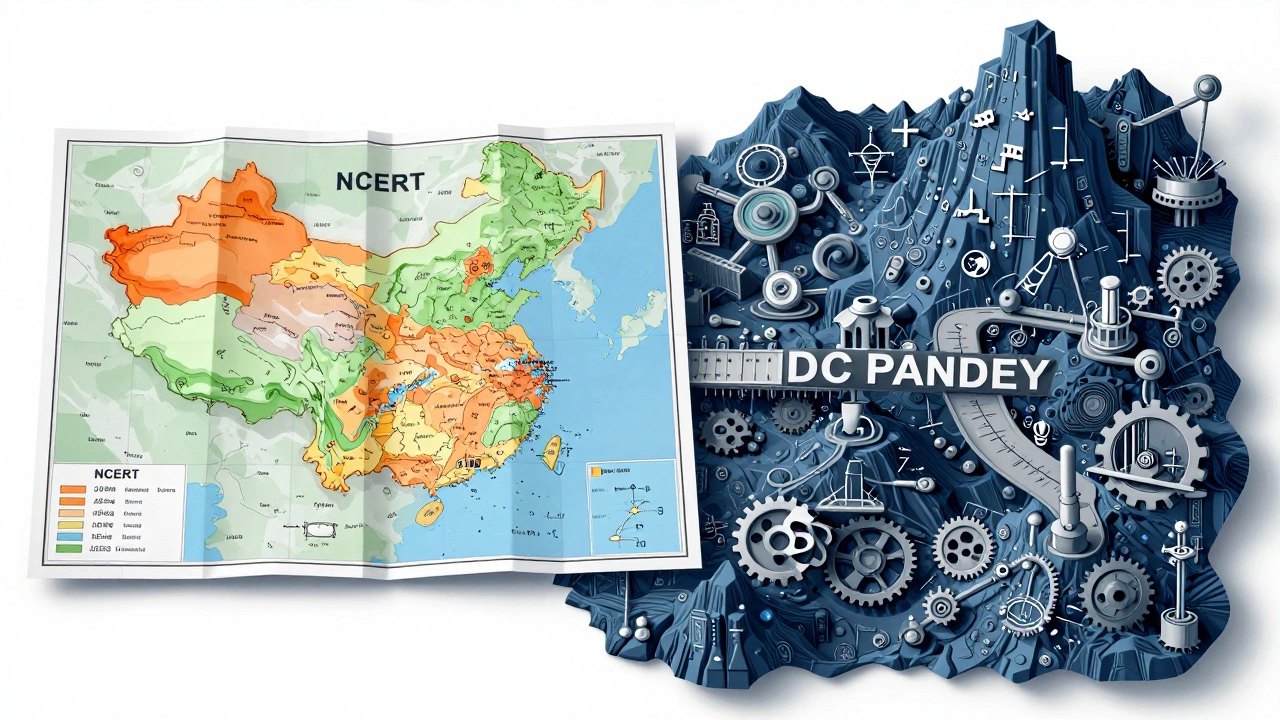
Who Should Actually Use DC Pandey for NEET?
Not every student needs DC Pandey. Here is a breakdown of who benefits from it and who should avoid it:
- The Topper Aspirant: If you are consistently scoring above 150/180 in Physics mock tests and aiming for an AIIMS or top government college seat, DC Pandey can help you polish your skills. Use it selectively for topics you already know well, to expose yourself to slightly trickier variations.
- The Conceptual Learner: If you understand the theory but struggle with applying it to new situations, the 'Illustrated Examples' section in DC Pandey is excellent. It shows step-by-step logic for complex problems.
- The Average Scorer: If you are scoring below 120/180 in Physics, do NOT start with DC Pandey. It will overwhelm you. Stick to NCERT and a simpler reference book like HC Verma (Concepts of Physics) or a dedicated NEET objective book like MTG NCERT at your Fingertips.
- The Time-Crunched Student: If you have less than six months left, DC Pandey is too bulky. Focus on previous years' questions (PYQs) and NCERT exemplars.
A Balanced Strategy: How to Combine Resources
If you decide to incorporate DC Pandey into your routine, do so strategically. Do not try to solve the entire book. That is impossible within the NEET timeline. Instead, follow this approach:
- Master NCERT First: Read the chapter in NCERT. Understand every line. Solve all in-text examples.
- Selective Problem Solving: Open DC Pandey. Skip the 'Advanced Level' problems. Focus on the 'Basic Exercises' and 'Objective Questions'. These align closely with NEET difficulty.
- Topic-Specific Usage: Use DC Pandey for topics that are heavily weighted and conceptually dense, such as Mechanics (Laws of Motion, Work Energy Power) and Electrodynamics. For Modern Physics or Semiconductors, NCERT and PYQs are usually sufficient.
- Time Management: Set a timer. If a problem takes more than 3-4 minutes, skip it. NEET is a speed game. You need to identify patterns quickly.
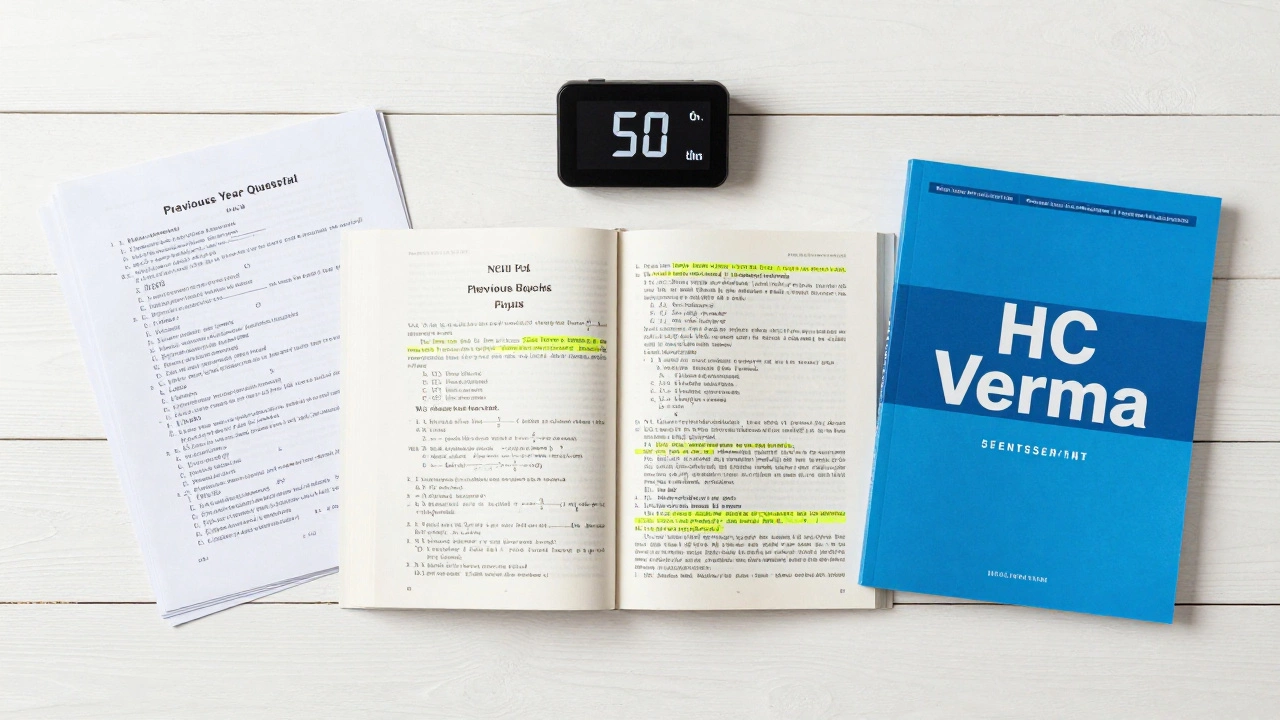
Better Alternatives for NEET Physics
If DC Pandey feels too heavy, there are other books tailored specifically for medical aspirants. These books bridge the gap between NCERT simplicity and JEE complexity without going overboard.
| Book Name | Best For | Difficulty Level | Alignment with NEET |
|---|---|---|---|
| NCERT Physics | Foundation building | Low | High (Concepts) |
| HC Verma | Conceptual clarity | Medium | High (Selected problems) |
| DC Pandey | Advanced practice | High | Medium (Requires filtering) |
| MTG NCERT at Your Fingertips | Quick revision & MCQs | Medium | Very High |
| Previous Year Questions (PYQs) | Exam pattern familiarity | Variable | Perfect |
HC Verma is often considered the gold standard for conceptual physics. It is less bulky than DC Pandey and focuses more on understanding why things happen rather than just calculating answers. For many NEET aspirants, HC Verma + NCERT is a more balanced combination than DC Pandey + NCERT.
Common Pitfalls to Avoid
Many students fall into traps when managing their study materials. Here are three major mistakes:
1. Ignoring Previous Years' Questions (PYQs): No book, including DC Pandey, predicts the exact style of NTA questions better than past papers. Solve at least the last 10 years of NEET/AIPMT papers. Analyze the trends. You will notice that many questions are repeats or slight modifications of older ones.
2. Neglecting Mock Tests: Reading solutions is not the same as solving problems. You must take full-length mock tests under timed conditions. This helps you manage stress and improves your speed. If you can't finish the physics section in 50 minutes during practice, you won't do it in the exam.
3. Hoarding Books: Buying five different physics books does not make you smarter. It creates confusion. Pick one primary resource (NCERT), one secondary resource (like DC Pandey or HC Verma), and stick to them. Depth beats breadth.
Final Verdict for 2026 Aspirants
Is DC Pandey enough for NEET? No. Is it useless? Absolutely not. It is a supplementary resource for those who have already mastered the basics and want to challenge themselves. For the majority of students, focusing intensely on NCERT, solving previous years' questions, and taking regular mock tests will yield better results than grinding through advanced engineering texts.
Your goal is not to become a physicist; it is to become a doctor. Keep your preparation focused, efficient, and aligned with the exam pattern. Don't let the fear of missing out on 'hard' questions distract you from mastering the 'core' questions that determine your rank.
Can I crack NEET with only NCERT Physics?
For most students, yes. NCERT provides the fundamental concepts required for NEET. However, relying solely on NCERT may leave you unprepared for complex numerical problems. It is highly recommended to supplement NCERT with a good objective question bank or previous years' question papers to practice application.
Which is better for NEET Physics: HC Verma or DC Pandey?
HC Verma is generally better suited for NEET aspirants because it focuses on conceptual clarity and has a moderate difficulty level. DC Pandey is more aligned with JEE and contains many problems that are too advanced for NEET. If you choose DC Pandey, you must be selective and skip the advanced sections.
How much time should I spend on Physics for NEET?
Physics should ideally consume about 30-40% of your daily study time, especially if it is your weaker subject. Consistency is key. Dedicate at least 2-3 hours daily to Physics, focusing on understanding concepts in the morning and solving numericals in the evening.
Is it necessary to solve all problems in DC Pandey?
No, it is neither necessary nor practical. DC Pandey contains hundreds of problems per chapter, many of which are JEE-level. For NEET, focus on the basic exercises and objective questions. Prioritize quality over quantity. Solving 50 relevant problems thoroughly is better than attempting 200 irrelevant ones.
What are the most important topics in Physics for NEET?
The high-weightage topics include Mechanics (Laws of Motion, Work Energy Power, Rotational Motion), Electrodynamics (Current Electricity, Capacitance, Magnetism), and Modern Physics. These topics consistently contribute 40-50% of the total marks. Master these first before moving to lower-weightage areas.