
English Fluency Path Finder
Identify your primary challenge to discover the most effective technique from the guide to close your "Fluency Gap".
Your Personalized Strategy:
Quick Wins for Immediate Progress
- Shadowing: Listen to a native speaker and repeat exactly what they say with a split-second delay.
- Self-Talk: Narrate your day in English (e.g., "Now I'm making tea, then I'll check my emails").
- Record & Compare: Record yourself speaking a paragraph, then listen to a native version and spot the difference.
- Think in English: Stop translating from your native tongue; start labeling objects and feelings directly in English.
The Psychology of the Fluency Gap
Most people struggle with fluency because they treat English is a West Germanic language that serves as the global lingua franca for business, science, and diplomacy like a school subject rather than a physical skill. Speaking a language is more like playing the guitar or swimming than it is like studying history. You can't learn to swim by reading a book about water; you have to get wet.
The biggest hurdle is often the "Affective Filter," a concept from Stephen Krashen, a linguist who argued that anxiety, low self-confidence, and boredom can literally block your brain from acquiring language. When you're terrified of making a mistake, your brain switches to a defensive mode, which kills your flow. To speak English fluently, you have to make peace with being "wrong" for a while. If you wait until your sentence is perfect before you speak it, you'll never speak at all.
Mastering the Art of Shadowing
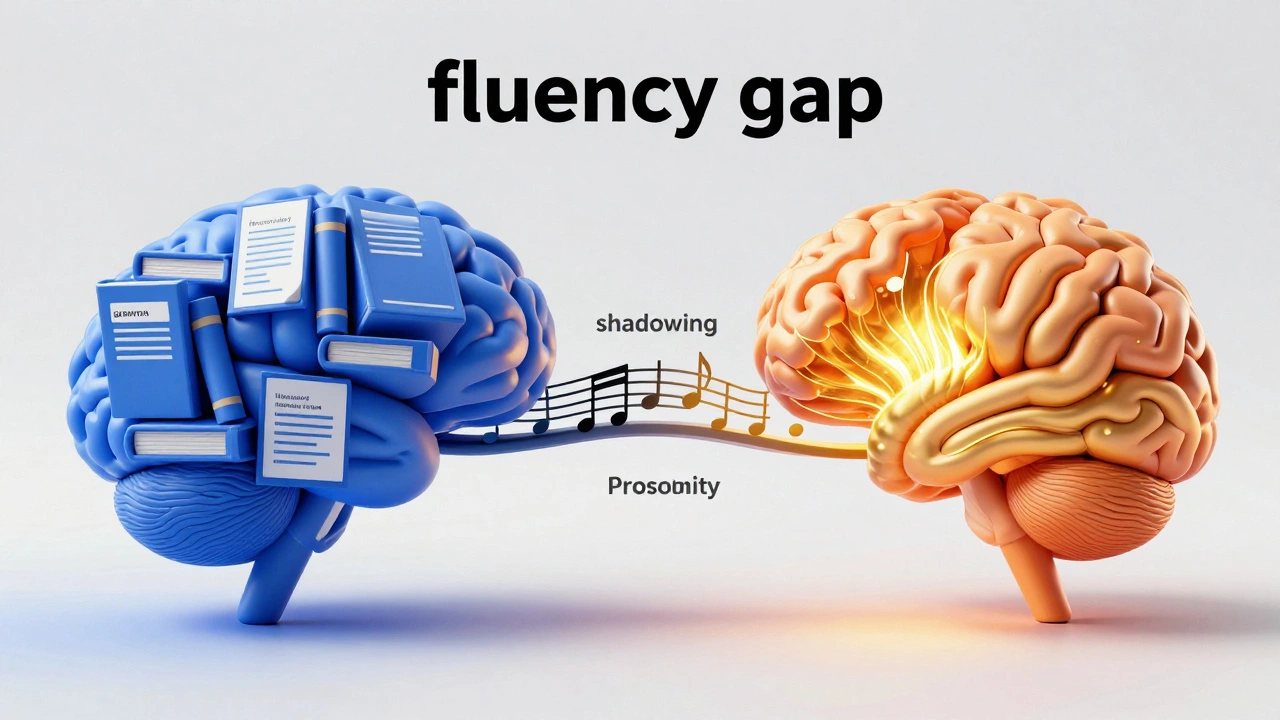
If you want to sound natural, you need to focus on Prosody, which is the rhythm, stress, and intonation of a language. Many learners sound robotic because they stress every word equally. In English, we use a stress-timed rhythm, meaning some syllables are long and others are almost invisible.
The most effective way to fix this is through Shadowing. Find a short clip of a speaker you admire-perhaps a TED Talk or a podcast. Don't wait for them to finish the sentence. Instead, mimic them almost instantly. You aren't just repeating words; you're mimicking the music of the language. If the speaker's voice goes up at the end of a question, your voice goes up too. If they pause for breath after a comma, you pause too. This trains your mouth muscles and your ears to recognize natural patterns without needing to analyze the grammar.
Building a High-Frequency Vocabulary
Stop trying to learn "big" words to sound smart. In reality, native speakers use a surprisingly small set of words for 80% of their daily conversations. If you focus on Collocations-words that naturally go together-you'll sound much more fluent than if you just learn individual vocabulary words.
For example, you don't "do a mistake," you "make a mistake." You don't have "strong rain," you have "heavy rain." When you learn a new word, always learn its "partners." This prevents the awkward pauses where you're trying to remember which adjective fits a specific noun. Instead of searching for a rare synonym, use Phrasal Verbs like "get over," "bring up," or "look into." These are the backbone of conversational English and are far more common in speech than their formal counterparts.
| Formal Word (Academic) | Conversational Alternative (Fluent) | Typical Context |
|---|---|---|
| Request | Ask for | Everyday needs |
| Determine | Find out | Solving a problem |
| Sufficient | Enough | Quantity/Time |
| Commence | Start / Get going | Beginning a task |
| Extinguish | Put out | Dealing with fire/lights |
Turning Your Environment into a Lab
You don't need to move to Canada or the UK to immerse yourself. You can create an "English Bubble" right where you are. Start by changing the language settings on your phone and laptop. It forces you to interact with the language in a functional, high-stakes way (like when you're trying to find a specific setting in your app).
Another powerful tool is Language Exchange. There are platforms where you can trade your native language for English practice. The trick here is to avoid the "Translation Trap." Many people spend half their time explaining a word in their own language. Set a rule: "No native language for 15 minutes." Use gestures, draw pictures, or describe the word using simpler English. This forces your brain to find alternative paths to convey a message, which is exactly what happens in a real-life conversation when you forget a specific word.
Overcoming the Fear of Public Speaking
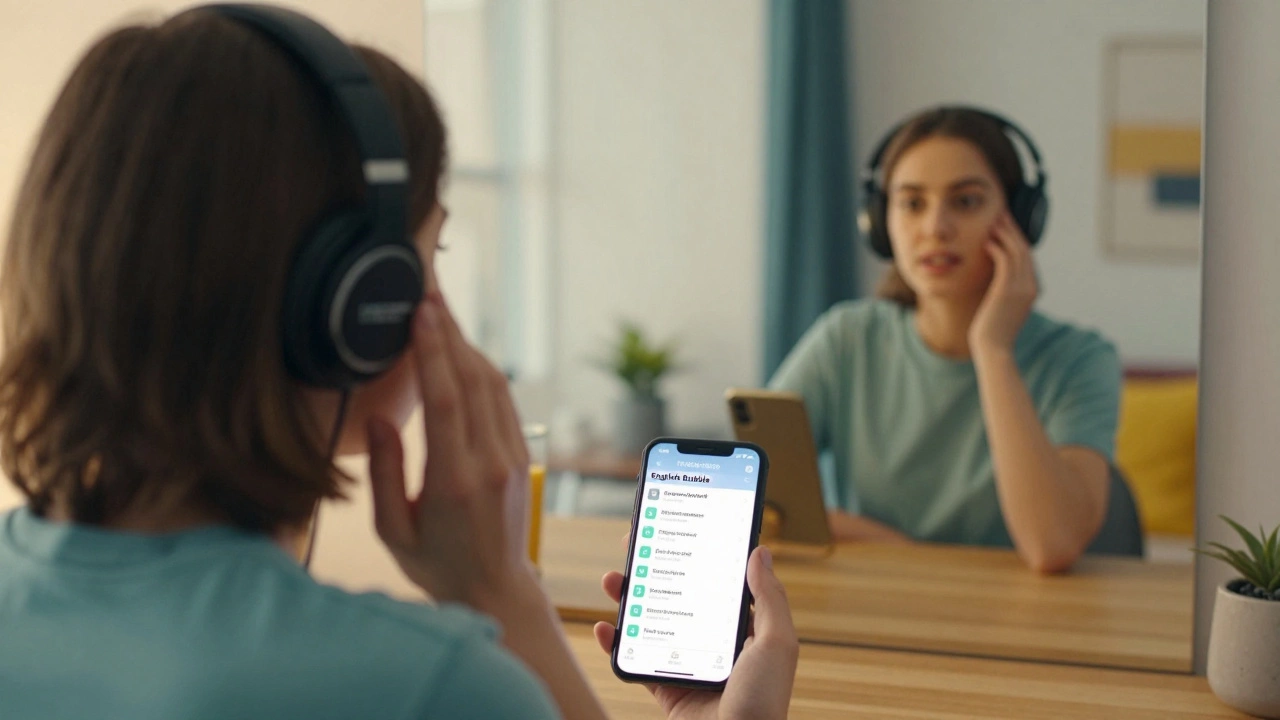
Fluency is as much about confidence as it is about linguistics. The fear of judgment is the biggest killer of progress. To beat this, start with low-stakes environments. Talk to your pet, talk to yourself in the mirror, or join a Toastmasters club-an international organization that helps people improve their public speaking and leadership skills in a supportive setting.
When you do enter a conversation, focus on the message, not the mechanics. If the other person understood what you meant, you've succeeded. Most native speakers are incredibly forgiving and will actually help you find the right word if you're struggling. The goal is communication, not perfection. If you stumble over a preposition, just keep going. The flow of the conversation is more important than a perfect tense.
Consistency Over Intensity
Spending five hours studying grammar on a Saturday is far less effective than spending thirty minutes speaking English every single day. Your brain needs constant, small repetitions to build the neural pathways required for automaticity. Automaticity is the stage where you no longer "translate" in your head; the English word simply appears as a reaction to a thought.
Create a daily habit loop. For example, listen to an English podcast during your commute, spend ten minutes shadowing a video during lunch, and write a short journal entry in English before bed. By touching the language multiple times a day, you signal to your brain that English is a vital tool for survival, not just a hobby. This is how you move from being a "student of English" to an "English speaker."
How long does it take to become fluent in English?
Fluency isn't a destination with a fixed date; it's a spectrum. However, for most learners, reaching a conversational level (B2 on the CEFR scale) typically takes between 600 to 1,000 hours of guided learning and practice. The speed depends heavily on your consistency and how much you actually speak versus how much you passively listen.
Can I become fluent without a teacher?
Yes, it is entirely possible. With the abundance of podcasts, YouTube channels, and language exchange apps, you have all the tools you need. The challenge is accountability. Without a teacher, you must be your own coach, setting a strict schedule and using recording tools to self-correct your pronunciation and grammar.
What should I do if I forget a word mid-sentence?
This is called "circumlocution." Instead of stopping, describe the word. If you forget the word "refrigerator," say "the cold box in the kitchen where we keep the milk." This keeps the conversation moving and actually makes you sound more fluent because it shows you can navigate the language flexibly.
Does grammar matter if I want to be fluent?
Grammar provides the skeleton, but fluency is the skin and muscle. You need basic grammar to be understood, but obsessing over complex rules will actually slow you down. Focus on "functional grammar"-the structures you actually use in daily speech-rather than academic rules you'll never use in a real conversation.
Is watching movies with subtitles helpful?
It depends on the subtitles. Native-language subtitles are less helpful because your brain focuses on reading, not listening. English subtitles are great for connecting sounds to words. For maximum growth, watch a scene with English subtitles, then watch it again without them to see how much you can catch by ear alone.