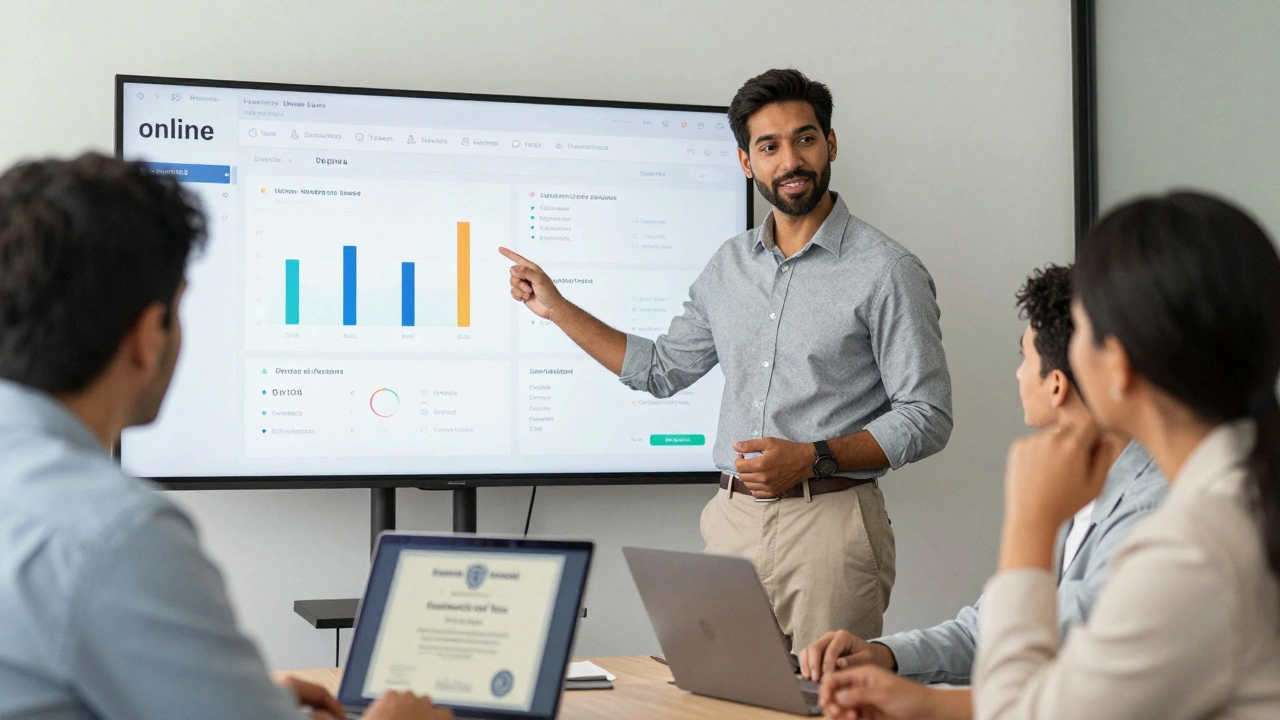
Back in 2015, if you told someone you got your degree online, they might’ve raised an eyebrow. Today? It’s a completely different story. More than 60% of U.S. employers now say they view online degrees as equally credible as traditional ones, according to a 2025 survey by the National Association of Colleges and Employers. That’s up from just 28% in 2018. The stigma isn’t gone entirely-but it’s fading fast. So, do employers dislike online degrees? The short answer: not anymore, if you know how to present it right.
Why the old bias still lingers
Some hiring managers still carry old assumptions. They picture someone clicking through videos on a couch in pajamas, barely passing a course while binge-watching Netflix. That stereotype comes from the early days of online education-when platforms were clunky, credentials were easy to fake, and few reputable schools offered them. But those days are over. Today, 94% of Ivy League and top public universities offer accredited online degrees. Harvard, Stanford, and the University of Michigan all award the same diploma whether you study on campus or online. The diploma doesn’t say ‘online.’ It just says your name and the school.Still, the myth sticks because of bad experiences. A 2024 study from the Society for Human Resource Management found that 18% of hiring managers had hired someone with an online degree who turned out to be underqualified. But here’s the catch: the same study found that 17% of hires with traditional degrees were underqualified too. The problem wasn’t the format-it was the school’s quality. A degree from a for-profit diploma mill is still a red flag, no matter how it’s delivered.
What employers actually care about
Employers aren’t scanning your resume looking for the word ‘online.’ They’re looking for results. What skills did you build? What projects did you complete? Did you manage your time while working full-time? Did you lead a team project remotely? Those are the things that matter.Take Sarah, a marketing coordinator in Toronto. She earned her MBA online while working 50-hour weeks at a startup. She didn’t just take quizzes-she ran a real social media campaign for a local nonprofit, tracked ROI, and presented findings to her class. When she applied for a senior role, her portfolio and project examples outweighed the delivery method. Her interviewer later told her: ‘I didn’t care how you got the degree. I cared that you got results.’
Companies like Google, Apple, and IBM have dropped degree requirements entirely for many roles. Instead, they focus on skills assessments, portfolio reviews, and micro-credentials. If you’ve earned a Google Career Certificate in data analytics or completed a Coursera specialization in project management, that often carries more weight than a generic degree label.
The hidden advantage of online degrees
Online learners often have skills traditional students don’t. They’re used to managing deadlines without a professor breathing down their neck. They know how to collaborate across time zones. They’ve used tools like Slack, Trello, Zoom, and Notion daily. These aren’t just tech skills-they’re workplace skills.A 2025 report from LinkedIn found that 72% of hiring managers rated online degree holders higher in self-discipline and time management than their campus-based peers. Why? Because they had to balance work, family, and study. That’s not easy. That’s resilience.
One tech recruiter in Vancouver told me: ‘I’d rather hire someone who finished an online computer science degree while raising two kids and working nights than someone who coasted through four years of campus life with no real-world experience.’
Which degrees are viewed as most credible?
Not all online degrees are treated the same. Here’s what’s working in 2026:- Business degrees from AACSB-accredited schools (like Arizona State, UNC, or Indiana University) are widely accepted. Many mid-level managers now hold online MBAs.
- Technology degrees from universities like Georgia Tech or Northeastern are seen as gold standards. Their online CS programs are nearly identical to on-campus ones.
- Education and healthcare degrees? More scrutiny. Teaching licenses and nursing credentials require clinical hours and state approval. Online programs here must be regionally accredited and approved by licensing boards. If they are, they’re trusted.
- Liberal arts degrees? Still face skepticism unless from elite institutions. But even here, employers are shifting. A degree in psychology from the University of Florida Online? Now viewed as legitimate if paired with internships or volunteer work.
Bottom line: Accreditation matters more than delivery. Always check if the school is regionally accredited (like by the Higher Learning Commission or Middle States Commission). Avoid any school that isn’t.
How to make your online degree shine on your resume
If you have an online degree, don’t hide it. Own it. But don’t just list it. Frame it.Here’s how to write it right:
- Don’t write ‘Online MBA.’ Write ‘Master of Business Administration, University of Texas at Dallas.’
- Under the degree, add a 1-line achievement. Example: ‘Led a cross-functional team project that improved campus student retention by 22%.’
- Include relevant coursework or capstone projects. If you built an app, wrote a research paper, or designed a marketing plan-name it.
- Link to your portfolio or LinkedIn profile. If you have GitHub, Behance, or a personal site, add it. Let your work speak.
One job seeker in Calgary added this line under her online bachelor’s in communications: ‘Graduated top 5% of cohort; managed full-time job while completing thesis on digital media ethics.’ She got five interviews in two weeks.
What to avoid
Don’t make these mistakes:- Don’t list a degree from a school with no accreditation. It’s a red flag.
- Don’t say ‘I got my degree online’ in an interview unless asked. Lead with your skills.
- Don’t compare yourself to traditional students. Focus on your strengths.
- Don’t use ‘self-taught’ as a substitute for a real degree unless you have certifications to back it up.
And please, never lie. Employers run background checks. If you claim a degree from a school that doesn’t offer it, you’ll get caught. And you’ll lose more than a job-you’ll lose trust.
Is an online degree worth it in 2026?
Yes-if you pick the right program and use it wisely. The average salary increase for someone with an online master’s is 28%, according to a 2025 PayScale report. That’s nearly identical to the 29% increase for traditional master’s grads.And the cost? Online degrees are often 40-60% cheaper than on-campus ones. Plus, you save on relocation, housing, and commuting. That’s not just smart-it’s strategic.
More than 4 million students in the U.S. and Canada are enrolled in online degree programs right now. That’s not a niche. It’s mainstream. Employers know that. The question isn’t whether they dislike online degrees. It’s whether you’ve built something worth their attention.
Do employers check if a degree is online?
Most don’t unless they’re verifying accreditation. Employers care about the school, not the delivery method. They’ll check if the university is accredited and if the degree exists-not whether you studied online. Your resume should list the school and degree name only, not ‘online.’
Are online degrees from for-profit schools trusted?
Generally, no. For-profit schools like University of Phoenix or DeVry have a reputation for low academic standards and high dropout rates. Even if they’re accredited, many employers still view them skeptically. Stick to regionally accredited public or nonprofit universities. If a school feels like a sales pitch, it probably is.
Can I get hired without a degree if I have online certificates?
Absolutely. Companies like Google, Amazon, and IBM now hire based on skills, not degrees. If you have certifications from Coursera, edX, or Google Career Certificates-and you can prove your skills through projects-you can land tech, marketing, and admin roles without a bachelor’s. But for leadership or regulated roles (like nursing or teaching), a degree is still required.
Do online degrees hurt my chances for promotions?
Only if your company culture is outdated. In most modern workplaces, promotions are based on performance, leadership, and results-not where you studied. If you’re excelling in your role, your degree format won’t hold you back. But if you’re in a traditional industry like banking or government, some managers may still hold biases. In those cases, build a strong track record and let your work speak louder than your diploma.
Should I mention my online degree in a cover letter?
Only if it helps tell your story. For example: ‘While working full-time, I completed my MBA online, managing a team of 12 and leading a 6-month digital transformation project.’ That shows initiative. But if you’re applying for a role where the degree is just a checkbox, just list it on your resume. Don’t explain unless asked.