Learning Path Selector
Answer a few questions
Let’s cut through the noise. If you’re trying to decide between distance learning and classroom learning, you’re not just picking a mode of study-you’re choosing how you’ll live, work, and grow over the next few years. And no, it’s not about which one is "better" in theory. It’s about which one fits your life right now.
What distance learning actually looks like in 2026
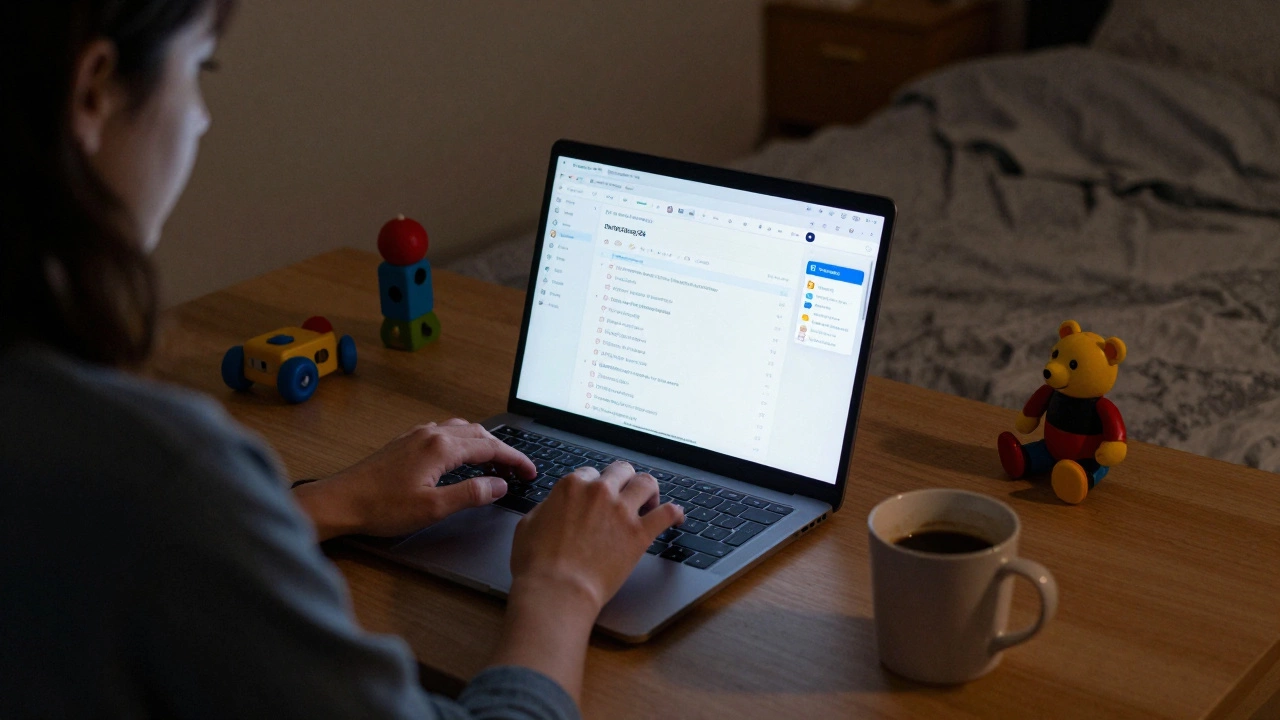
Distance learning isn’t just watching videos and clicking quizzes anymore. Today, it’s a structured ecosystem. You get live Zoom sessions with instructors who’ve taught at top universities, AI-powered feedback on your assignments, peer study groups on Discord, and digital portfolios hosted on platforms like Notion or GitHub. Schools like Arizona State and the University of Toronto now offer full degree programs online with the same accreditation as their on-campus versions.
Here’s what it really means day-to-day:
- You log in at 7 a.m. before your shift at the grocery store.
- You finish a module during your lunch break while sitting in your car.
- You submit a project at 11 p.m. after putting your kids to bed.
There’s no commute. No parking fees. No need to buy expensive textbooks-most are free or included in your tuition. But here’s the catch: you’re responsible for everything. If you miss a deadline, no one reminds you. If you’re stuck on a concept, you have to reach out, search forums, or book a tutor. There’s no professor walking by your desk to ask, "Hey, you good?"
What classroom learning still delivers that online can’t
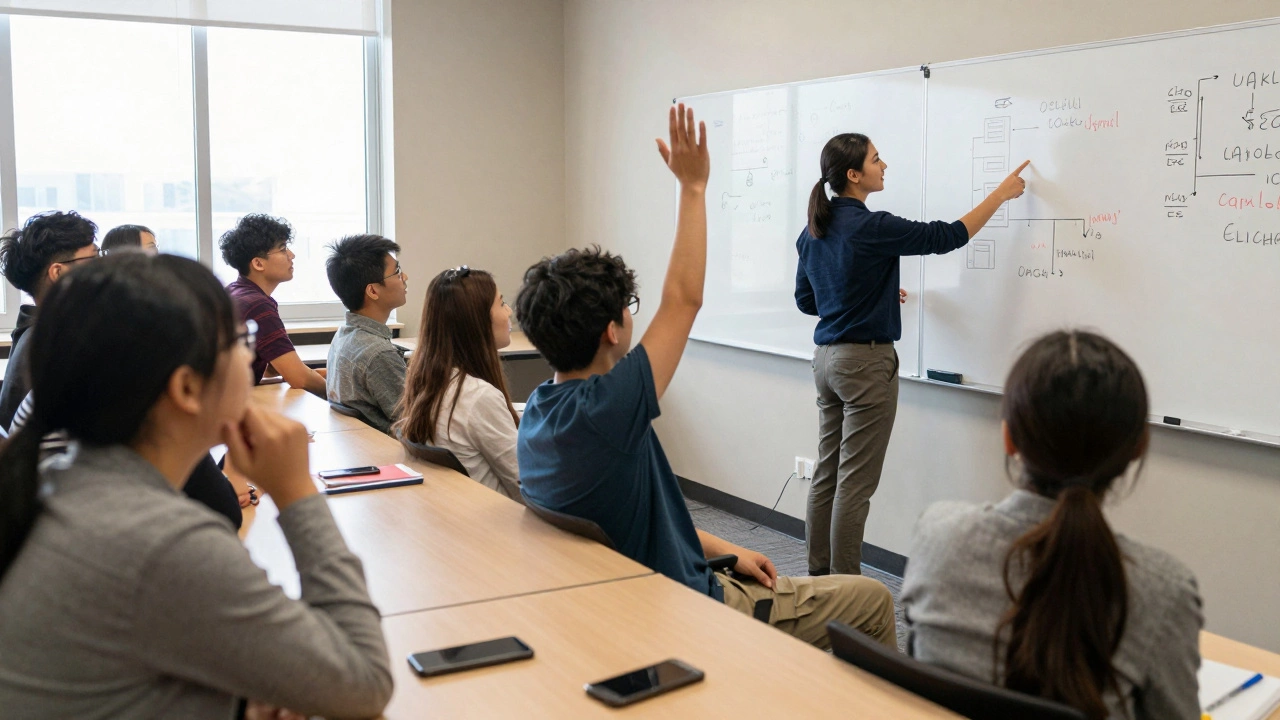
Walk into any university lecture hall in Toronto, and you’ll see the same thing: heads down, pens scratching, someone’s phone buzzing under the desk. But then-something happens. A student raises their hand. A debate breaks out. Someone says something unexpected, and suddenly, the whole room shifts. That’s not a video. That’s human chemistry.
Classroom learning still wins in three areas:
- Immediate feedback-Your professor sees you struggle and pulls you aside after class.
- Networking-You meet the person who’ll later hire you, collaborate with you, or become your co-founder.
- Structure-Classes start at 9 a.m. You show up. You’re in a room full of people doing the same thing. That momentum is real.
But let’s be honest: classroom learning also means paying $15,000 a year in tuition, living in a dorm, buying meals you don’t like, and dealing with 20-minute bus rides that eat into your study time. And if you’re working full-time or raising kids? Good luck fitting it in.
Who thrives in distance learning?
Distance learning isn’t for everyone-but it’s perfect for some. Here’s who it works for:
- Working adults-If you’re earning a paycheck and trying to upskill, online programs let you learn without quitting your job.
- Parents-You can study while your toddler naps. No daycare costs. No schedule conflicts.
- People in rural areas-If you live outside a city with no local college, online is your only path to a degree.
- Self-starters-You don’t need someone watching you. You set your own pace. You’re motivated by results, not attendance.
A 2025 study by the Canadian Centre for Education Statistics found that 78% of adult learners who completed an online certificate program did so while employed full-time. That’s not luck. That’s design.
Who still needs the classroom?
Some fields simply can’t be learned through a screen. If you’re training to be:
- A nurse
- An electrician
- A physical therapist
- A welder
- A teacher doing student practicums
-then you need hands-on time. You need to feel the pulse. You need to hold the tool. You need to see the reaction in a child’s eyes when you explain something for the first time.
Even in fields like business or computer science, some learners benefit from the energy of a room. The group projects. The late-night study sessions. The accidental conversations that turn into internships.
Cost comparison: Real numbers in 2026
Let’s get concrete. Here’s what you’re actually paying:
| Expense | Distance Learning | Classroom Learning |
|---|---|---|
| Tuition (annual) | $3,500-$8,000 | $12,000-$25,000 |
| Books and materials | $100-$300 | $800-$1,500 |
| Transportation | $0 | $1,200-$3,000 |
| Housing (if relocating) | $0 | $8,000-$15,000 |
| Lost income (if quitting job) | $0 | $20,000-$40,000 |
That’s not a typo. For many, classroom learning costs five times more than online-not just in tuition, but in lost wages and living expenses. And if you’re paying that much, you’d better be sure the return on investment is real.

The hidden advantage: flexibility isn’t just convenient-it’s transformative
One of the biggest mistakes people make is thinking online learning is "easier." It’s not. It’s harder in ways no one talks about.
You have to build discipline. You have to create your own routine. You have to fight distraction. But here’s the secret: those are the exact skills employers are looking for now.
Companies don’t just want someone who can solve a coding problem. They want someone who can manage their time, meet deadlines without supervision, and learn independently. Online learners develop those skills by default. They’re not just getting a degree-they’re proving they can work in the modern world.
And here’s something else: employers can’t tell the difference anymore. A degree from the University of Toronto online looks identical to one from campus on your resume. The transcript doesn’t say "distance." The diploma doesn’t say "online." And in interviews, no one asks. They care about what you know, not how you learned it.
What’s the real deciding factor?
It’s not about which method is "better." It’s about your situation:
- If you need structure, accountability, and in-person connection-go to campus.
- If you’re working, parenting, or living far from a school-online is your lifeline.
- If you’re learning a hands-on trade-find a program with labs and mentors.
- If you’re building a career, not just a credential-choose the path that lets you keep earning while you learn.
There’s no right answer. Only the right choice-for you.
Can you get a job with an online degree?
Yes-absolutely. Major companies like Google, IBM, and Apple now hire candidates with online degrees from accredited institutions. In fact, a 2025 LinkedIn report showed that 62% of hiring managers said they couldn’t tell the difference between online and in-person degrees on resumes. What matters is the skills you demonstrate, the projects you’ve built, and how well you can explain what you’ve learned.
Is distance learning harder than classroom learning?
It’s different, not easier. Distance learning requires more self-discipline. You don’t have a professor reminding you of deadlines or classmates to motivate you. You have to create your own structure. Many people struggle at first-but those who stick with it often end up more resilient, organized, and independent than their classroom peers.
Do online programs offer the same support as on-campus ones?
Top online programs now offer full support: 24/7 tutoring, career counseling, mental health services, and even virtual study lounges. Schools like the University of Toronto and Ryerson offer online students the same access to libraries, academic advisors, and job fairs as on-campus students. The difference is how you access it-you log in instead of walking down the hall.
Are online degrees accredited the same way?
Yes. Accreditation doesn’t depend on delivery method. A degree from an accredited institution is valid whether it’s earned online or in person. In Canada, check if the school is recognized by provincial education authorities or national bodies like the Canadian Information Centre for International Credentials (CICIC). If it’s accredited, the degree holds the same weight.
What if I’m not good with technology?
Most online programs require basic tech skills-using email, uploading files, joining Zoom calls. That’s it. Many schools offer free tech orientation courses before classes start. If you can use a smartphone or a laptop, you can handle online learning. You don’t need to be a tech expert-you just need to be willing to learn a few new tools.
Final thought: The future isn’t online or in-person-it’s hybrid
The real winner isn’t distance learning or classroom learning. It’s flexibility. More schools are offering hybrid models now: you take core courses online, then come in for labs, internships, or capstone projects. That’s the future. And if you’re choosing between two extremes today, ask yourself: which path keeps your options open tomorrow?